A card that earns the most on groceries may not be the best fit for someone who spends more on everything else. Our Best Cash Back Credit Cards picks compare simple flat-rate rewards with category-based options and useful perks. The right choice depends on where we spend and how much effort we want to put into tracking rewards.
We’ll look at cards for mixed purchases, groceries, gas, dining and other common needs. A reward cap is the maximum amount of eligible spending that earns a card’s bonus rate during a set period. Responsible use matters more than chasing a headline offer, since interest and extra spending can eat into rewards.
We can keep the process practical: match the card to spending we already expect, then read its current terms. Flexible rewards and valuable perks matter only when we can use them. The strongest pick is the one that fits regular spending without encouraging purchases we would not otherwise make.
Key Takeaways
- Flat-rate cards can suit mixed spending with little tracking.
- Category cards can reward eligible groceries, gas, dining or other purchases.
- Bonus rates may have spending caps or activation rules.
- Interest and annual fees can reduce the value of rewards.
- Compare an offer’s spending goal with purchases already in our budget.
Best Cash Back Credit Cards for Different Spending Styles
For broad everyday use, we would start with a flat-rate card; people with concentrated grocery or gas spending may do better with a category card. Our shortlist covers both styles, including cash back credit cards with no annual fee and one card with a first-year fee waiver.
Offers and terms can depend on the application offer. The welcome offer is a sign-up bonus, and its spending requirement should fit normal purchases. A cash rewards credit offer may also arrive as points, rather than cash deposited at once.
Choose the card that fits spending we already expect. Do not spend extra just to reach a sign-up bonus.
| Card | Best fit | Annual fee | Welcome offer |
|---|---|---|---|
| Wells Fargo Active Cash | Flat-rate spending | $0 | $100 after $500 in 3 months |
| Citi Double Cash | Purchase-and-payment rewards | $0 | $200 after $1,500 in 6 months |
| Blue Cash Everyday | Groceries, gas and online retail | $0 | Offer as high as $200 |
| Quicksilver | Uncomplicated purchases | $0 | $200 after $500 in 3 months |
| Blue Cash Preferred | Groceries and streaming | $0 in year one, then $95 | Offer as high as $300 |
Wells Fargo Active Cash offers $100 after $500 in purchases during the first three months. Citi Double Cash offers $200 after $1,500 in purchases in six months, fulfilled as 20,000 ThankYou Points redeemable for $200 cash back.
Blue Cash Everyday has an offer as high as $200, while Quicksilver offers $200 after $500 in three months. Blue Cash Preferred’s offer is as high as $300, but those amounts are not guaranteed for every applicant.
For people looking for the best cash back credit cards for 2026, the main choice is still spending style, not the calendar year. Compare the offer’s spending requirement with purchases already in your budget rather than spending extra to qualify.
Which card gives a simple 2% on purchases?
Someone who wants one rate for routine purchases can earn unlimited 2% cash rewards with Wells Fargo Active Cash. The card gives the same base rate across eligible purchases, so we do not need category activation. That steady rate makes it a simple flat-rate cash back option.
Every $100 in eligible purchases earns $2 in cash rewards. The Wells Fargo Active Cash Visa Signature card also has a 0% intro APR for 12 months from account opening on purchases and qualifying balance transfers.
Wells Fargo Active Cash Visa Signature benefits
The Wells Fargo Cash Back Visa Signature card benefits include its unlimited 2% rate and the introductory APR period. People searching for fargo active cash details can compare those benefits with their own payment habits.
The card’s cash rewards credit applies across eligible cash back purchases, rather than only in selected spending groups. That can help when monthly spending shifts between bills, meals and errands.
Can a purple Wells Fargo card be identified as Active Cash?
A purple Wells Fargo card cannot be reliably identified as Active Cash by color alone. Card designs can vary, so we should check the printed product name and account terms.
Color may help us recognize a card, but it does not confirm the product’s rewards or conditions. Check the product name and current terms rather than choosing by card color.
How does Citi Double Cash pay its 2%?
Citi Double Cash splits its 2% into 1% when you buy and another 1% as you pay for those purchases. The second portion arrives as you pay down eligible purchases, not at checkout.
The full 2% is not earned at the moment of purchase. Cardholders must pay at least the minimum due on time to earn cash back.
For example, a $100 purchase can earn $1 when made, then another $1 as the balance is paid. If we carry the purchase for a while, the remaining reward follows the payment instead of arriving right away.
This purchase-and-payment setup makes Citi Double Cash different from a rewards credit card that gives its full rate when a transaction posts. It also ties cash back purchases to timely payments.
Keep the payment schedule in mind when comparing the advertised rate with a card that pays rewards at purchase. Pay at least the minimum due on time to qualify for the cash back.
Which no-fee card rewards groceries, gas and online shopping?
Blue Cash Everyday suits shoppers whose regular spending falls across supermarkets, online retail and gas stations. It earns 3% cash back at U.S. supermarkets, on U.S. online retail purchases and at U.S. gas stations. Those three categories cover common household errands.
The $6,000 yearly reward cap applies separately to each category. After eligible purchases pass a category’s limit, they earn 1% in that category for the rest of the year.
This everyday card American households may consider gives the same 3% rate in all three named groups. The supermarket category refers to U.S. supermarkets, while online retail purchases must qualify under the card’s terms.
The card’s cash back U.S. categories are not a single shared pool. A shopper could reach the $6,000 limit on gas purchases without using any of the separate supermarket or online retail limit.
Track each category’s yearly total, especially if routine spending rises during holidays or travel seasons. Check category totals before assuming every purchase in a high-spend category will continue earning 3%.
Is Quicksilver better for uncomplicated spending?
Quicksilver keeps most purchases simple with 1.5% cash back, without requiring quarterly category activation. That broad coverage can suit cardholders who prefer one general rate and do not want to track rotating offers.
Its general rate is not the highest among the cards covered here. Capital One Quicksilver earns 5% on hotels, vacation rentals and rental cars booked through Capital One Travel.
The 5% rate applies to eligible travel booked through Capital One Travel, not every travel purchase. Most other cash back purchases earn the general 1.5% rate.
That structure makes Quicksilver an uncomplicated cash back card, though a category-focused option may pay more on eligible spending. A flat-rate alternative can also return more on ordinary purchases.
If we rarely book through the travel portal, the elevated rate may affect only a small part of our budget. Compare its everyday rate with a flat 2% alternative if most of your spending is outside the travel portal.
How strong are Blue Cash Preferred’s grocery and streaming rewards?
Households with substantial supermarket spending and eligible streaming subscriptions may get more value from Blue Cash Preferred’s higher category rates. It earns 6% at U.S. supermarkets on up to $6,000 per year in eligible purchases, then 1%. The limit matters for larger grocery budgets.
The 6% supermarket rate stops after $6,000 in eligible yearly purchases. The card also earns 6% on select U.S. streaming subscriptions, 3% at eligible U.S. gas stations and on transit, and 1% elsewhere.
The cash preferred card treats streaming, gas and transit as distinct categories. Select U.S. streaming services qualify, while gas purchases must be at eligible U.S. stations.
Transit can include eligible purchases, but it does not mean every trip or travel charge earns the bonus. Other purchases earn 1%, so the card’s return depends on how much spending fits its listed groups.
For a preferred card American families are comparing with a no-fee option, count supermarket spending that falls within the annual cap. Check how much of your grocery spending falls under the annual cap before comparing its return with a no-fee alternative.
How do rotating-category cards work?
Rotating-category cards can earn 5% in selected categories, but the cardholder must activate the offer and follow the quarterly cap. Discover it Cash Back requires quarterly activation. The bonus changes as the selected categories change.
The 5% rate applies to up to $1,500 in purchases per quarter. Purchases outside the current bonus categories earn unlimited 1% cash back.
The reward cap limits how much spending earns the 5% rate during each three-month period. Once spending in the activated categories reaches $1,500, further purchases do not earn that quarter’s bonus rate.
Discover cash back can work well when the current categories match regular expenses. It takes more attention than a fixed-rate card because we need to activate the offer and keep track of the cap.
Other card purchases still earn 1%, which gives cardholders a base return outside the bonus groups. Set a reminder to activate each quarter if you want the bonus rate.
Which card covers dining, drugstores and travel?
Chase Freedom Unlimited combines a 1.5% rate on other purchases with higher rewards for Chase Travel, dining and drugstores. Its mix suits people who want several everyday bonus categories.
Travel earns 5% only when purchased through Chase Travel. The card earns 3% on dining at restaurants and drugstore purchases, plus 1.5% on all other purchases.
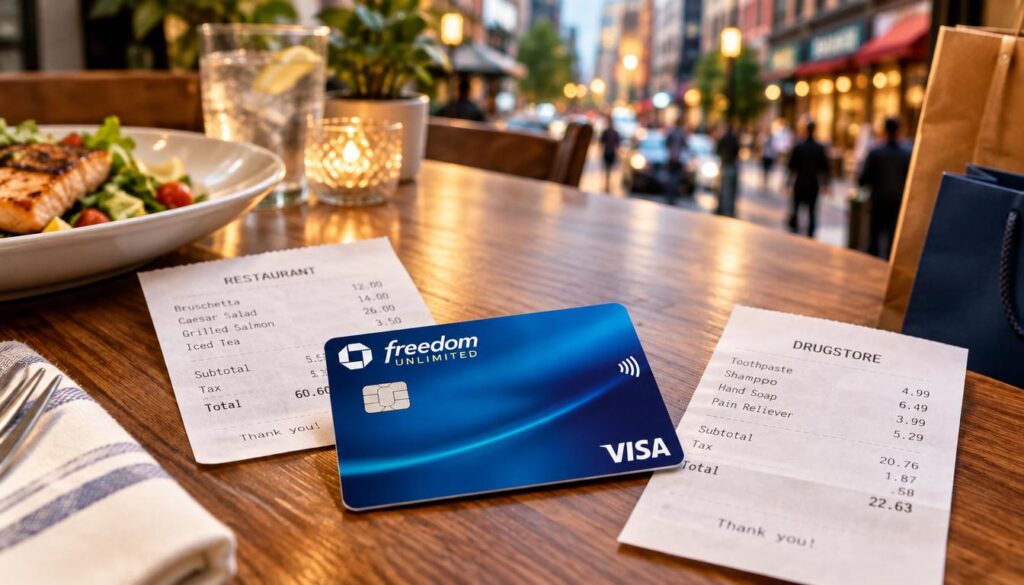
The Chase Travel rate does not cover every trip booked elsewhere. Restaurant spending and drugstore purchases earn the same 3% rate, while other eligible transactions use the base rate.
Chase Freedom Unlimited has a $0 annual fee. Its mix of rates can suit people who dine out, buy items at drugstores and book trips through Chase’s portal.
For cash back credit shoppers, the 1.5% base rate applies beyond those named categories. Check whether your travel is booked through Chase Travel before counting on the 5% rate.
When do category-specific alternatives fit?
A card built around one chosen category, dining and entertainment, or quarterly bonuses can outperform a simple flat rate for the right spender. The best match depends on which eligible purchases already fill our budget.
Bank of America Customized Cash Rewards lets cardholders change their selected category monthly. Its 3% category and 2% grocery and wholesale club rates share a $2,500 quarterly spending cap.
| Card | Rewards that set it apart | Annual fee | Welcome offer |
|---|---|---|---|
| Bank of America Customized Cash Rewards | 3% in one chosen category and 2% at grocery stores and wholesale clubs within the quarterly combined cap | $0 | $200 |
| Capital One Savor | 3% dining, entertainment, popular streaming and grocery purchases | $0 | $200 after $500 in 3 months |
| Chase Freedom Flex | Activated 5% rotating categories up to $1,500 quarterly, plus 5% Chase Travel and 3% dining and drugstores | $0 | $250 after $500 in 3 months |
Bank of America Customized Cash Rewards earns 3% in one of six chosen categories and 2% at grocery stores and wholesale clubs. Those rates apply to up to $2,500 in combined quarterly purchases, then spending earns 1%.
Capital One Savor offers 3% on dining, entertainment, popular streaming and grocery purchases. Walmart and Target purchases do not qualify for its grocery rate, so those stores should not be counted in a Savor cash rewards estimate.
Chase Freedom Flex earns 5% in activated rotating categories on up to $1,500 per quarter. It also earns 5% on Chase Travel, 3% on dining and drugstores, and 1% elsewhere.
The Bank of America card has a $200 introductory offer, Savor offers $200 after $500 in three months, and Freedom Flex offers $250 after $500 in three months. Each has a $0 annual fee; Savor’s bonus is one Savor offer to compare against spending already planned.
Choose a category card only when its eligible purchases match spending you already expect to make.
How should we match a card to our spending?
On $5,000 in annual purchases, moving from a 1% rate to a 2% rate raises the simple cash return from $50 to $100. That $50 gap shows why our spending pattern matters.
A card’s highest rate is not automatically its most valuable rate. Caps, eligible purchases and the time needed to track categories can lower actual earnings.
How flat-rate and category rewards compare
| Rewards structure | Typical rate pattern | Management required | Best fit |
|---|---|---|---|
| Flat-rate | One rate across eligible purchases | Little tracking | Mixed everyday spending |
| Fixed-category | Elevated rate in listed categories with any stated caps | Follow category definitions and caps | Concentrated spending |
| Rotating-category | Changing bonus categories up to the stated cap | Activate and track categories | Organized cardholders willing to manage the calendar |
Which card structures can earn the highest cash back?
Rotating cards can reach 5% in activated categories, while some fixed-category cards also offer high rates. Flat-rate cash back is easier to manage, and it can suit spending spread across many types of purchases.
On $5,000 of eligible spending, 1% returns $50, 2% returns $100, 3% returns $150, 4% returns $200, and 5% returns $250. A 5% rate gives 5 cents per eligible dollar, compared with 1 cent at 1%.
Those amounts assume all $5,000 qualifies for the stated rate. A reward cap or category rule can shift some spending to a lower rate, shrinking the difference.
People comparing the highest cash back credit cards should weigh that math against the effort of managing each rewards credit card. The best cash back cards can have different structures for different households.
Base the choice on actual eligible purchases, not the largest percentage printed in an offer.
How can we redeem cash rewards?
Cash back generally stays in the card account until the cardholder chooses an available redemption method. Common choices include a statement credit, direct deposit, gift cards, charity donations and checkout options.
Check the value per point and any minimum before redeeming. Statement credits and direct deposits often offer strong value, while some gift cards may return only 0.5 cents per point.
Common ways to use cash back
A statement credit reduces the card balance, while an eligible direct deposit moves rewards to a bank account. Some issuers also let cardholders use rewards at Amazon checkout or donate them to charity.
Gift cards can have a different value from cash, so compare before making a choice. A statement credit checkout option may be convenient, but convenience does not guarantee the best return.
Wells Fargo Active Cash redemption rules
Wells Fargo Active Cash rewards can cover eligible purchases starting at $13. Cardholders can also credit rewards to an eligible Wells Fargo credit-card or checking account.
Other options include PayPal for eligible purchases and gift cards from more than 250 merchants. E-gift cards start at $10, and rewards do not expire while the account remains open.
Blue Cash Preferred issues Reward Dollars, redeemable as a statement credit or at Amazon.com checkout. Chase Freedom Unlimited has no minimum cash redemption; cardholders can choose a statement credit or electronic deposit to an eligible U.S. Chase account.
Check the minimum redemption amount and value per point before selecting a non-cash option.
Are sign-up bonuses and intro APR offers worth considering?
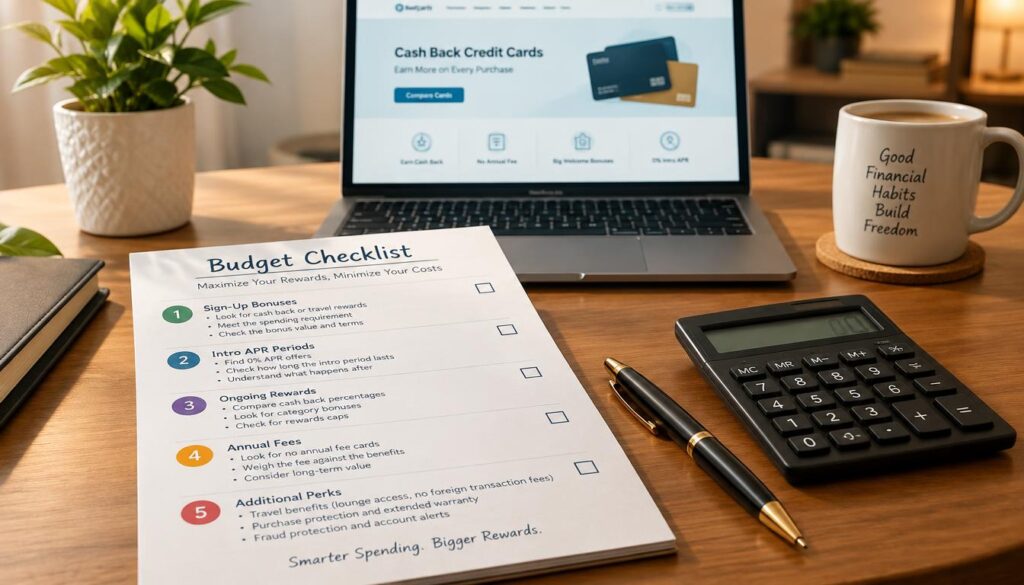
A large bonus or 0% period is useful only when its terms fit a purchase or balance plan you already have. Normal spending should meet any bonus threshold without adding unplanned costs.
An intro APR ends on a set date, and balance transfers can have fees or deadlines. Read the full offer before moving a balance or relying on a low rate.
When a sign-up bonus fits your budget
Compare a bonus with the spending requirement and the time allowed to meet it. For example, Chase Freedom Unlimited offers $200 after $500 in purchases during the first three months.
A bonus cash back offer is useful when the purchases are already in our budget. A $200 reward does not make extra spending a good deal if it creates debt or strains monthly bills.
What a 0% intro APR can and cannot do
Wells Fargo Active Cash offers a 0% intro APR for 12 months from account opening on purchases and qualifying balance transfers. Transfers must be made within 120 days to qualify for the introductory rate and fee.
Chase Freedom Unlimited and Chase Freedom Flex offer 0% intro APR for 15 months on purchases and balance transfers. Their promotional period lasts three months longer than the Wells Fargo period.
Before using purchases balance transfers, check when the offer starts, which transactions qualify and what transfer fee applies. The phrase apr purchases balance matters because an offer may cover purchases and balance transfers under separate terms.
- Confirm the spending requirement.
- Check the offer window.
- Note the balance-transfer deadline.
- Find the transfer fee.
- Set a payoff plan.
Read how a reward will be received, including whether points or cash arrive after the qualifying period. Set a payoff date before relying on any promotional APR.
What can reduce the value of cash back?
A carried balance can cost far more than a year of rewards, even on a card with a strong earning rate. Interest can grow while the reward balance stays small.
At a 20% APR, carrying $1,000 for a year would cost roughly $200 in interest, before fees and payment timing. That can wipe out rewards from substantial spending.
| Card | Variable APR | When it applies |
|---|---|---|
| Citi Double Cash | 18.49%-28.74% | Ongoing |
| Blue Cash Everyday | 19.74%-28.74% | Ongoing |
| Wells Fargo Active Cash | 18.74%, 24.74% or 28.74% | After its intro period |
The apr 18.49 27.99 range sometimes seen in card comparisons is not the rate shown for these cards. Their listed rates vary by product and, for the first two, apply on an ongoing basis.
| Annual spend | Return at 1% | Return at 2% | Difference |
|---|---|---|---|
| $1,000 | $10 | $20 | $10 |
| $2,500 | $25 | $50 | $25 |
| $10,000 | $100 | $200 | $100 |
Annual fees also reduce net value. A card with an annual fee first charged after a waived period may still cost more than its rewards return; check whether the fee applies in the first year.
The Consumer Financial Protection Bureau warns that hiding reward terms or failing to deliver promised benefits can harm cardholders. Its consumer rewards enforcement notice also discusses reward changes and retail-card costs.
- Pay the balance in full when possible.
- Calculate net rewards after any annual fee.
- Avoid spending more to chase a rate.
Treat rewards as a small return on planned spending, not as a reason to borrow.
Are credit card cash back rewards taxable?
Cash back earned from personal purchases is generally treated as a reduction in the purchase price rather than taxable income. That usual rule covers rewards tied to spending on personal credit cards.
A sign-up reward that requires no purchase is generally taxable income. If its value exceeds $600, the issuer must report it to the IRS and send Form 1099-MISC.
This treatment differs from purchase rebates, which lower the effective cost of what we bought. Keep the offer terms with records of rewards, especially when the card gives a bonus without requiring a purchase.
Cash or gift-card rewards earned by an employee using a corporate credit card are taxable income to that employee. That exception applies to employee rewards, not ordinary personal-use purchase rewards.
Credit card rewards can raise questions when a bonus has unusual terms or a work card is involved. Ask a tax professional or the IRS about an unusual situation.
Keep the offer terms and any tax form if a reward falls into a taxable exception.
How can we avoid common cash back mistakes?
The easiest way to lose the value of rewards is to spend more than planned or carry a balance to chase them. A reward is not a discount if the purchase would not otherwise fit our budget.
Paying interest or buying extra can erase the value of cash back. We should treat rewards as a small return on planned spending, not permission to spend more.
Keep rewards from changing spending habits
A 5% offer can look tempting, but the rate applies only to eligible spending under its terms. Buying something unnecessary to earn a few dollars can leave us paying much more than we receive.
Cardholders can also miss rewards by overlooking a cap or forgetting to activate rotating categories. A quick calendar reminder helps when a bonus needs a new activation each quarter.
Check credit and account terms before applying
Credit cards that earn rewards often require good credit, with FICO 680 or higher serving as a common benchmark. That number is a guide, not a promise of approval.
Some secured cards offer cash back, but they typically require a deposit. A common credit-utilization rule of thumb is to keep revolving credit use below 30%; lower use is generally preferable, though it does not guarantee a score outcome.
Before applying, check these account basics:
- Confirm which purchases qualify for rewards.
- Track category caps and required activations.
- Pay at least the minimum due on time.
- Review statements and current card terms.
Read the terms closely because reward rules and account costs affect actual value. The CFPB has warned about hidden reward conditions and promised benefits that cardholders do not receive.
Do not let a reward rate change what we buy. Check the costs and rules before applying.
Review the latest card terms and your monthly budget before submitting an application.
Conclusion
The best fit is the card that rewards the purchases you already make and that you can manage comfortably. A simple flat-rate option can suit mixed spending, while category cards may suit households with concentrated eligible purchases.
Our next step is concrete: review the last few months of spending and mark where a higher rate would apply. That check can show whether a category card’s limits and rules fit our routine.
Compare your recent spending with the card’s current terms before you apply.