A low credit score does not automatically rule out a credit card, but the right choice depends on what you can afford and what an issuer will approve. The Best Credit Cards for Bad Credit can help you compare options as you work to rebuild credit and improve your credit score. Approval depends on more than a score, including income, debt, and an issuer’s rules.
We compare deposit-backed and no-deposit cards, their costs, and their credit reporting. We also explain how responsible use can support a stronger credit history without promising approval or a quick score change. The goal is a practical shortlist that fits your budget, not a guarantee that any card will accept you.
Key Takeaways
- A secured card requires a refundable security deposit.
- An unsecured card does not require a deposit, but may charge higher fees.
- Approval depends on more than your credit score.
- On-time payments and low balances can support credit rebuilding.
- Compare fees, credit reporting, and deposit terms before applying.
Compare the card’s full fees and reporting practices before applying, not just its headline feature.
Which Are the Best Credit Cards for Bad Credit in 2026?
For many people rebuilding credit, the Capital One Platinum Secured is a useful first card to compare because it has no annual fee and can require a deposit as low as $49. Its low starting deposit can make it easier to consider than cards that need $200 upfront.
The strongest fit depends on whether you value a low deposit, rewards, or access without a credit check. Capital One Quicksilver Secured suits readers who want rewards, while OpenSky Secured Visa may suit those seeking no credit check. None guarantees approval.
The Capital One Platinum Secured has a $0 annual fee and a 29.24% variable APR. A $49, $99, or $200 refundable deposit can qualify for a minimum $200 credit line. CardRates lists it as an option for applicants with bad credit.
The strongest fit depends on whether you value a low deposit, rewards, or access without a credit check.
Our #1 credit card to have in this context is the one that fits your finances and needs. A $0 annual fee does not mean borrowing is free, and a high credit limit is not assured.
| Card | Type | Annual fee | APR |
|---|---|---|---|
| Capital One Platinum Secured | Secured | $0 | 29.24% variable |
| Capital One Quicksilver Secured | Secured | $0 | 29.24% variable |
| OpenSky Secured Visa | Secured | $35 | 23.89% variable |
| Credit One Bank Secured Card | Secured | $0 | 29.74% variable |
| Discover it Secured | Secured | $0 | 26.49% variable |
The Discover it Secured deposit starts at $200 and can reach $2,500. The lowest advertised fee matters less than whether the deposit and monthly bill fit your budget.
What Is the Difference Between Secured and Unsecured Cards?
A secured card requires a refundable deposit, while an unsecured card gives access to credit without tying up that cash. The main tradeoff is cash upfront versus the fees, limits, or terms offered without collateral.
Bad credit has no universal score cutoff. Scores generally range from 300 to 850, and scoring models can label the same score differently. FICO calls scores below 580 poor, while WalletHub uses below 640 for its unsecured-card comparison.
How a secured card uses a deposit
A security deposit generally sets the credit limit on a secured credit card. A $200 deposit is common, and many secured cards require at least $200 to $500. A $500 deposit usually supports a credit limit of at least $500.
The issuer may return the deposit after an upgrade or account closure, subject to its rules and any balance owed. Issuers may see a secured application differently because the deposit offers some protection if the cardholder does not pay.
What no-deposit unsecured cards trade off
An unsecured card does not tie up savings, but its fees and starting limit may be less favorable. Compare these three details before choosing:
- Whether the deposit fits your budget.
- The annual fee and any other charges.
- Whether the issuer reports to all three credit bureaus.
Choose a secured card if a deposit is manageable and its costs are lower than the no-deposit alternatives you qualify for.
Is Capital One Platinum Secured a Strong First Pick?
The Capital One Platinum Secured can suit applicants who want a $0 annual fee and a deposit option below the usual $200 starting point. That smaller option may help when cash is tight, but approval is not assured.
No credit score is required to apply, yet income and existing debt can still lead to a decline. Capital One reviews those financial conditions, so a low-score application is not automatically accepted.
The card reports account status to all three major credit bureaus. That reporting can help build a record when payments arrive on time, but it does not guarantee a score increase.
You can pay the deposit at once or in installments during the 35 days after approval. Capital One may return it if the account upgrades to an unsecured card, or after you close the account and pay the balance in full.
The card has no foreign transaction fees, replacement card fees, or authorized user fees. Still, a $0 annual fee does not erase its 29.24% variable APR. Interest can add up if you carry a balance.
Before applying, confirm that the deposit schedule and any balance you might carry work with your budget.
Which Secured Cards Offer Cash Back?
For a secured card that earns cash back on every purchase, Capital One Quicksilver Secured offers 1.5%, with a higher rate on eligible Capital One Travel bookings. Flat-rate rewards make it simple to earn cash back without tracking several spending groups.
Rewards matter only if fees and interest do not outweigh what you earn. Rates apply under each card’s terms, and a high APR can quickly cost more than modest cash-back purchases return.
Quicksilver Secured earns 5% on hotels, vacation rentals, and rental cars booked through Capital One Travel. Credit One Bank Secured Card earns 1% on eligible gas, grocery, mobile phone, internet, cable, and satellite TV purchases.
| Card | Annual fee | Cash-back terms | APR |
|---|---|---|---|
| Capital One Quicksilver Secured | $0 | 1.5% on purchases; 5% on eligible Capital One Travel bookings | 29.24% variable |
| Discover it Secured | $0 | 2% at gas stations and restaurants, up to $1,000 quarterly; 1% elsewhere | 26.49% |
| Credit One Bank Secured Card | $0 | 1% on eligible listed categories | 29.74% variable |
| First Latitude Secured | $0 | Up to 10% at participating merchants; 1% on payments | 27.74% variable |
Discover matches the cash back you earn after the first year and starts account reviews after seven months. Its bonus categories need activation, and funding the deposit requires a bank account.
First Latitude’s higher rate applies only at participating merchants. Check each card’s reward rules, since cash back is limited by the issuer’s terms.
Pay the statement balance in full when possible, since interest can outweigh modest cash-back earnings.
Is OpenSky Secured Visa a Good Choice Without a Credit Check?
OpenSky Secured Visa is worth comparing when avoiding a credit check matters more than avoiding an annual fee. No credit check can appeal to applicants who want to avoid that step, but it does not mean guaranteed approval.
The refundable deposit starts at $200 and can set the credit limit. OpenSky may let you pay it without a bank account, which can help applicants who do not use one.
The card charges a $35 annual fee and has a 23.89% variable APR. Those costs apply even if rewards are not a priority, so include them when checking whether the account fits.
OpenSky reports account activity to the credit bureaus. Cash-back offers may be available to eligible cardholders, but their terms and eligibility rules apply. Do not assume every purchase earns a reward.
People often ask which is the easiest credit card to get with bad credit. A secured card is often easier to qualify for because a deposit reduces issuer risk, but the issuer still reviews applications.
Set aside the deposit and annual fee together when judging whether the card is affordable.
Should You Choose a Secured Card With a Lower APR?
First Progress Prestige Secured has the lowest APR among these three options, at 13.74% variable, but it charges a $49 annual fee. A lower rate can matter if you carry a balance, yet it does not make borrowing cheap.
APR matters when you carry a balance, while an annual fee is charged whether or not interest accrues. Compare both costs with your likely use of the card.
| Card | Variable APR | Annual fee |
|---|---|---|
| First Progress Prestige Secured Mastercard | 13.74% | $49 |
| First Progress Select Secured Mastercard | 17.74% | $39 |
| OpenSky Secured Visa | 23.89% | $35 |
The First Progress Select Secured Mastercard has a 17.74% variable APR and a $39 annual fee. OpenSky Secured Visa has a 23.89% variable APR and a $35 annual fee.
A lower APR can reduce interest compared with a higher rate, but balances still grow costly when they remain unpaid. A lower annual fee may be better for someone who pays in full each month.
If you pay every statement in full, compare annual fees and other costs before choosing based on APR alone.
Which Unsecured Cards Are Worth Considering With Bad Credit?
Unsecured cards can provide credit without a security deposit, but their fees and starting limits need close scrutiny. No deposit keeps cash available for other bills, though it can come with a higher price.
The best credit cards for bad credit with no deposit are offers whose fees and limit fit the applicant. A card advertised as easy approval may still carry costly terms or offer little spending room.
No-deposit cards with lower or no annual fees
Avant Mastercard has a $0 annual fee in the offer shown. Its APR is 29.99%, so the lack of an annual fee does not make carrying a balance inexpensive.
The Milestone Mastercard requires no security deposit. Checking whether an applicant is approved does not affect the applicant’s credit score if the issuer does not approve them.
When a no-deposit offer may cost more
Some no-deposit cards charge annual or monthly fees that use up part of a small credit limit. An offer for a $500 credit card with no deposit is not assured, and neither is approval.
Check the exact limit and full terms of the offer you receive. A smaller limit can leave less room for purchases after fees post, even before interest applies.
Do not apply until the offer shows the annual fee, any monthly fee, APR, and starting credit limit.
What Fees and APRs Can Unsecured Cards Charge?
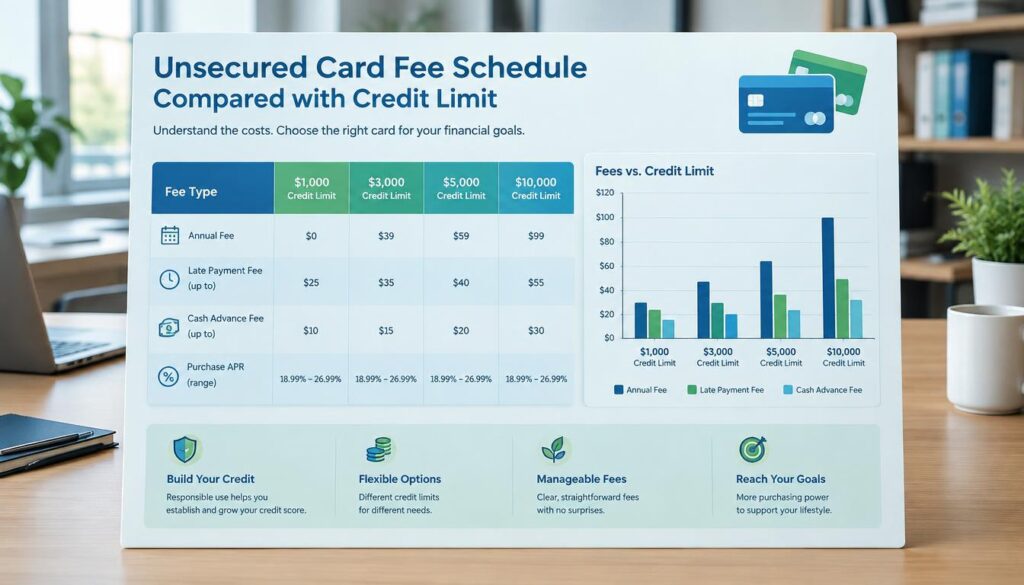
A no-deposit card may still be expensive: some offers combine a high first-year fee with a separate monthly fee later. Fees can change after the first year, so compare both periods before accepting an offer.
Check the full fee schedule and APR, not just the advertised annual fee. The Consumer Financial Protection Bureau’s credit card agreement database lets readers search agreements, though an issuer’s account-specific agreement may differ.
| Card | Annual fee | APR |
|---|---|---|
| Credit One Bank American Express for Rebuilding Credit | $75 first year; $99 thereafter | 29.74% variable |
| FIT Platinum Mastercard | $99 first year; $125 thereafter | 35.90% fixed |
| Revel Platinum Mastercard | $49-$125 | 35.90% fixed |
| Reflex Platinum Mastercard | $75-$125 | 35.90% fixed |
| Avant Mastercard | $0 in shown offer | 29.99% |
Credit One Bank Platinum Visa for Rebuilding Credit starts with a $300 limit. It charges $75 the first year, then $99 annually, with a 29.74% variable APR.
Indigo Mastercard offers a $700 limit, a $175 first-year fee, and a $49 annual fee later. A $12.50 monthly fee begins after the first 12 months.
Surge Platinum Mastercard charges a $75-$125 annual fee and a $12.50 monthly fee after the first year. Fortiva Cash Back Rewards Mastercard has an $85-$175 first-year fee, then $49 annually and $15 monthly after year one. Its APR is 36% fixed.
Ollo Everyday Rewards has a $0 annual-fee offer and a 23.99%-29.99% variable APR, with cash back in stated categories. Terms can vary by offer, so calculate the first-year and later-year costs separately before accepting an offer.
Can You Get a $500, $1,000 or $2,000 Limit With Bad Credit?
A secured card can make a $500 limit more attainable when its terms set the limit against a deposit, but approval still is not guaranteed. The deposit may help set a secured card’s credit limit, while unsecured cards for damaged credit often start lower.
No card can promise a $1,000 or $2,000 limit with guaranteed approval based only on bad credit. The issuer sets the approved limit after reviewing the applicant and the offer terms.
A $500 security deposit gives a credit limit of at least $500 on the secured cards described as typical by Navy Federal. Adding to a deposit can raise the limit on some secured cards, subject to the issuer’s rules.
Unsecured cards for bad credit tend to have low spending limits. A $500 credit card may be possible, but neither a $500 limit nor approval is assured.
- Compare the stated starting limit.
- Check whether a larger secured deposit can raise it.
- Leave room in your budget for fees and payments.
Treat a promised high limit as unconfirmed until the issuer gives you the actual approved terms.
Are Store Cards Easier to Get With Bad Credit?
Store cards can be another route to consider, but a retailer name alone does not make approval certain. Some store cards work only at one retailer, unlike a general-purpose card accepted at many merchants.
Store cards do not guarantee easier approval. Department store limits usually start around $150-$500, and interest rates often fall around 25%-30%. Those are general estimates, not terms for every card.
Retailer cards to compare
Options for people rebuilding credit include the Kohl’s Card, JCPenney Credit Card, Macy’s Credit Card, TJX Rewards Card, and Old Navy Navyist Rewards card. Each retailer sets its own terms and approval rules.
What store-card applications still assess
An issuer may review credit history, income, current debt, and recent applications. A store card can be a poor fit if you want to use the account for bills outside that retailer.
Read whether the card works only at the retailer or across a broader payment network before applying.
What Affects Approval When Your Credit Score Is Low?
A low score is only one part of an application, since issuers may also consider income, existing debt, and recent credit activity. Your finances matter alongside the details in your credit file.
No card is guaranteed to approve every applicant. A card that does not require a credit score can still review financial details and decline an application.
Income and current debt
Capital One may decline Platinum Secured applicants who do not meet income and existing-debt conditions. That can happen even though no credit score is required to apply.
Store-card issuers may also weigh whether income can support the requested limit. For example, low income may not support a $300 limit under an issuer’s standards.
Recent applications and credit-file problems
Several hard inquiries in the past six months or an open collection of $500 or more may lead to a store-card denial. Issuers set their own standards, so one factor does not decide every case.
Prepare these details before applying:
- Your current income.
- Your recurring debt payments.
- Your recent applications and unresolved collections.
The most realistic card offers depend on your finances and the issuer’s rules. Apply only when the card’s requirements fit your current finances, not because an advertisement promises approval.
Does Prequalification Hurt Your Credit Score?
A prequalification check usually uses a soft inquiry, which does not affect your credit score, but it cannot guarantee approval. Prequalification is a first look, not an account approval.
A formal application will likely trigger a hard inquiry. The issuer may review the full application and make a different decision after checking more details.

Capital One’s pre-approval check uses a soft inquiry. A formal application typically triggers a hard inquiry that could temporarily affect credit scores.
Use these steps to shop with fewer surprises:
- Check whether the issuer uses a soft inquiry.
- Read the offer’s conditions.
- Submit a formal application only after comparing terms.
A prequalified offer can help narrow card offers, but it does not replace the issuer’s final review. Confirm whether the next step is a formal application before authorizing a credit check.
How Can You Use a Card to Rebuild Credit?
Consistent on-time payments and modest balances are the habits to prioritize after opening a credit card. Steady use can help build a positive record without taking on costly debt.
Credit utilization is the share of your available credit that your card balance uses. Navy Federal recommends keeping secured-card use below 30% of the credit line each month.
Pay on time and keep balances low
Payment history and reported balances can shape how lenders view your credit use. Set a payment routine that matches your paydays, and avoid spending more than you can repay.
Carrying a balance is not needed to build credit. Interest adds cost without creating a special credit-building benefit, so pay the statement balance in full when possible.
- Set a payment reminder or autopay.
- Keep the balance below 30% of the limit as a practical target.
- Pay the statement balance in full when possible.
- Review credit reports for correct account information.
Make the card part of a sustainable routine
Use the card for a small planned purchase, such as a monthly bill, then track the charge. Keep enough cash in your bank account to cover the payment when it comes due.
Set a payment reminder for before the due date and keep enough cash available to pay the statement.
When Can a Secured Card Return Your Deposit or Upgrade?
A secured-card deposit is generally returned when the issuer upgrades the account or when the account closes with its balance paid, subject to the card’s terms. The timing depends on the issuer’s review and account rules.
An upgrade can return a deposit, while a higher credit line may not require another deposit. Those are different account changes, so ask which one the issuer is offering.
Capital One may consider Platinum Secured cardholders for a higher credit line in as little as six months, without an additional deposit. A higher line alone does not mean the account became unsecured.
Responsible use may make a secured card eligible for an unsecured upgrade after as little as six months of on-time payments. Eligible Navy Federal cashRewards Secured cardholders could be considered after three months.
These timelines are examples, not promises. Review timing and eligibility vary by issuer, and keeping a card open for a set time does not guarantee an upgrade.
Ask the issuer what action triggers a deposit refund and whether you must request an account review.
What Should You Do Before Applying?
Before submitting an application, make sure the card’s deposit, fees, and likely limit fit your budget. A quick review can help you avoid applying for a card that costs more than you can manage.
Check all three credit reports for errors before choosing a card. Review the full fee schedule, confirm that any security deposit is affordable, and apply for one suitable card rather than several at once.
The Consumer Financial Protection Bureau provides a searchable database of issuer credit card agreements. You can also request your specific agreement from the issuer, since database terms may not match an individual account.
If an issuer declines your application, it must send an adverse-action notice that explains the reasons. Read those reasons and address them before applying again.
If denied, use the stated reasons to decide what to fix before applying again.
Conclusion
The right card is the one whose approval requirements, total costs, and credit-building features fit your current situation. A deposit-backed option can be a practical starting point when the deposit is affordable, while no-deposit cards call for close fee checks.
Compare the annual fee, APR, deposit, credit reporting, and upgrade terms against your budget before applying. Choose one card to compare in full, confirm its current terms, and apply only when the costs are manageable.