Some featured 0% offers last 21 months, giving us nearly two years to pay down a balance without interest. We would start by matching the 0% offer to the balance we need to pay down, rather than choosing a card for its headline alone.
An intro APR is a temporary annual percentage rate that applies to specified purchases or balance transfers for a set promotional period. The right card depends on whether we need time for new purchases, a way to move existing debt, or rewards while paying.
Wells Fargo Reflect offers a long payoff runway, while Chase Freedom Unlimited suits readers who value rewards. We compare these and other credit card offers, explain key terms, and show how to set a payoff plan. A credit score and account opening approval also affect which offers we can use.
A 0% offer only helps when its terms and our monthly budget leave enough room to finish paying the balance.
Key Takeaways
- Match the offer to purchases or a balance transfer.
- Compare the promotional period with the time we need to repay.
- Count any balance transfer fee before moving debt.
- Plan for the regular APR if a balance remains.
- Choose rewards only for spending we already expect.
- Check the card’s full terms before applying.
Best Credit Cards with 0% APR for Different Goals
For most people, we would first choose between a long payoff period and a shorter offer with ongoing rewards. Wells Fargo Reflect has the longest payoff runway among our featured picks, while Chase Freedom Unlimited pairs financing with rewards.
The best credit cards depend on whether we need purchases balance financing, cash back, or a balance transfer. These four alternatives focus on purchase financing and rewards, not on every existing balance. The stated welcome offer may change by card version or application.
Choose a 0% offer for the balance we need to pay, then weigh rewards as a useful extra.
| Card | Purchase intro APR | Rewards rate | Stated welcome offer |
|---|---|---|---|
| Bank of America Customized Cash Rewards | 15 billing cycles | 1%-6% cash back | $200 |
| Discover it Cash Back | 15 months | 1%-5% cash back | $200 plus Cashback Match |
| Blue Cash Everyday | 15 months | 1%-3% cash back | Up to $200 |
| Capital One Quicksilver | 15 months | 1.5%-5% cash back | One-time $200 |
Bank of America Customized Cash Rewards has a 0% intro APR on purchases for 15 billing cycles. Its cash back ranges from 1% to 6%, and its stated offer is $200.
Discover it Cash Back gives 0% on purchases for 15 months, with 1%-5% cash back. Its $200 offer comes with Cashback Match, while Blue Cash Everyday offers 15 months and up to $200.
Capital One Quicksilver has 15 months at 0% on purchases, earns 1.5%-5% cash back, and offers a one-time $200 bonus. An existing balance may call for a different card than these purchase-focused picks.
Check the application terms for the offer attached to the exact card version before applying.
What Does a 0% APR Offer Cover, and How Long Can It Last?
A 0% intro APR can cover purchases, transferred balances, or both, but the card terms determine which transactions qualify. Check the transaction type before relying on an intro APR offer.
The longest offers in this roundup last 21 months or 21 billing cycles, not 24 or 36 months. So a Visa credit card with no interest for 24 months and a 36-month interest-free credit card are not among these featured offers.
Purchase offers cover new spending
A purchase offer applies to eligible new purchases. It does not automatically cover balance transfers or cash advances, even when those transactions appear on the same credit card.
Some intro APR cards cover both purchases and balance transfers. The terms may set different deadlines or periods for each, so one promotion does not prove that every transaction qualifies.
Balance transfer offers move existing debt
A balance transfer offer applies to debt moved from another account. The transfer may share an intro APR period with purchases, but it needs its own stated promotion.
Chase Slate and Chase Freedom Flex both offer 0% intro APR on purchases and balance transfers, with different lengths. Chase Slate’s 21-month offer starts from account opening; Freedom Flex offers 15 months from account opening.
Compare these four details before choosing a card:
- Eligible transaction type
- Length of the offer
- Transfer deadline
- Regular APR afterward
Billing cycles and calendar months are not always the same count. Read the offer’s exact wording and note when the introductory period begins.
Before counting on an interest-free period, confirm that the exact balance we plan to pay is covered.
Best for a Long Purchase Payoff: Wells Fargo Reflect
Wells Fargo Reflect is a strong fit when we need one long promotional window for both a major purchase and a qualifying balance transfer. The 21-month period gives us a long time to pay, but its offer is not 24 months.
Purchases and qualifying balance transfers receive 0% intro APR for 21 months from account opening. Transfers must be made within 120 days of account opening to qualify.
A balance transfer fee applies: 5% of each transfer, with a $5 minimum. We should include that cost in the payoff amount, rather than treating the transfer as free financing.
Wells Fargo Reflect can suit someone paying for a large expense over time or moving a qualifying balance from another issuer. Its purchase offer and transfer offer cover different transaction types, even when their promotional periods match.
After the promotion, the regular APR becomes a variable 17.74%, 24.24%, or 28.49%, based on the account terms. Any balance left then accrues interest at the assigned rate.
We can divide the planned payoff by 21 to set a monthly goal, then leave room for the fee or new charges.
Do not assume every transfer qualifies just because the offer lasts 21 months. The 120-day deadline and qualifying-transfer rules still apply.
Set a payoff target that clears the balance before the 21-month promotional period ends.
What Does the U.S. Bank Shield Visa Card Offer?
U.S. Bank Shield is a strong all-purpose financing choice when we can complete an eligible transfer within its 60-day window. It covers both qualifying purchases and balance transfers for 21 billing cycles.
Transfers must post within 60 days of account opening and cost 5%, with a $5 minimum. Transfers from other U.S. Bank National Association accounts are not permitted.
U.S. Bank Shield’s 0% periods apply to purchases for 21 billing cycles and to eligible transfers made during that first 60 days. The transfer fee still applies during the promotion.
Cash advances do not receive the intro APR. A cash advance is not the same as a purchase or balance transfer, so we should not count on its promotional terms.
The card also gives an automatic $20 statement credit after 11 consecutive calendar months with purchases in a 12-month period. The account must be in good standing to receive it.
That statement credit is a small account benefit, not a payoff plan. We still need a monthly target that clears the balance before the intro APR ends.
The 60-day deadline matters if we plan to move existing debt. A transfer made after that window may not receive the promotional rate.
Do not plan around a transfer from another U.S. Bank account, because those transfers are not permitted.
Is Citi Diamond Preferred a Good Balance Transfer Card?
Citi Diamond Preferred is aimed more at moving existing debt than financing purchases for the same length of time. Its transfer period is longer than its purchase period.
The card offers 0% intro APR on balance transfers for 21 months and on purchases for 12 months. A credit card with no interest for 12 months can describe its purchase offer, but not its longer transfer offer.
Transfers must be completed within four months of account opening to qualify for the introductory terms. The completion deadline is important because submitting a transfer request may not mean it has finished.
The balance transfer fee is 3% of each transfer, with a $5 minimum, during the first four months. After that window, the fee rises to 5%, with the same $5 minimum.
The regular APR is a variable 16.74%-27.49%. Any amount left when the introductory APR ends can accrue interest at the rate assigned to the account.
This card can fit a borrower whose main goal is moving existing credit card debt. Its 12-month purchase promotion is shorter, so new spending needs a separate payoff plan.
Compare the transfer fee with the interest we expect to avoid before moving the balance.
Is BankAmericard Better for Purchase Financing?
BankAmericard stands out for readers who want a long purchase offer and may also need to move a balance. Both promotions last 21 billing cycles, but each has separate eligibility rules.
Its purchase offer is 0% for 21 billing cycles, and its transfer offer also lasts 21 billing cycles. The transfer offer applies only when we make the transfer within 60 days of account opening.
The balance transfer fee is 5%. That charge is separate from the introductory APR, so we should add it to the amount we intend to repay.
BankAmericard may work for planned new purchases when we can pay them within the promotional period. The transfer option may help with an existing balance, but its deadline and fee still matter.
The regular APR is a variable 15.24%-26.24%. We should budget for that rate if any balance remains after the promotion ends.
Do not assume that a purchase promotion covers a transferred balance. The two offers have separate terms, and the transfer has a 60-day window.
Complete any qualifying transfer within the first 60 days rather than assuming the purchase offer covers it.
Does Chase Freedom Unlimited Fit a Rewards-Focused Payoff Plan?
Chase Freedom Unlimited can work when we can pay on a 15-month schedule and will meet the bonus spending requirement without adding unnecessary purchases. The bonus has a spending threshold, so it should not steer the payoff plan.
The card offers 0% intro APR on purchases and balance transfers for 15 months from account opening. The $200 bonus requires $500 in purchases during the first three months.
The balance transfer fee is 3%, with a $5 minimum, during the first 60 days. After that, the fee is 5%, with a $5 minimum.
These terms can suit us if we can handle a shorter financing period. A new card may also tempt us to spend, so the bonus should come from purchases we already planned.
After the promotion, the regular APR is variable at 18.49%-27.99%. The rate applies to any remaining balance under the account terms.
For anyone comparing apr 18.49 27.99, this is the rate range that follows the intro period. The shorter financing window matters more than the bonus if our balance will take longer to repay.
Do not spend extra to earn a bonus if that makes the payoff balance harder to clear.
Which 0% APR Cards Add Useful Rewards?
Rewards are most useful when we would make the same eligible purchases without the card’s promotional financing. Cash back is an extra, not a reason to carry debt.
Chase Freedom Unlimited, Chase Freedom Flex, and U.S. Bank Shield each reward certain purchases. We should keep paying down the balance even when a purchase earns rewards.
| Card | Everyday or base rewards | Boosted category rewards and conditions |
|---|---|---|
| Chase Freedom Unlimited | 1.5% on other purchases | 3% dining and drugstores; 5% travel through Chase Travel |
| Chase Freedom Flex | 1% on other purchases | 3% dining and drugstores; 5% travel through Chase Travel; 5% on up to $1,500 in activated quarterly bonus-category purchases |
| U.S. Bank Shield | No listed base rate | 4% on eligible prepaid air, car, and hotel reservations booked through U.S. Bank Travel Center |
Chase Freedom Unlimited earns 1.5% on other purchases, 3% at dining and drugstores, and 5% on travel through Chase Travel. Those categories may fit regular spending.
Chase Freedom Flex earns 1% on other purchases, 3% at dining and drugstores, and 5% on travel through Chase Travel. It also earns 5% on up to $1,500 in combined activated bonus-category purchases each quarter.
U.S. Bank Shield earns 4% on eligible prepaid air, car, and hotel reservations booked through the U.S. Bank Travel Center. We should check whether those bookings match plans we already have.
Rewards credit can add value, but it cannot cancel interest after a promotion ends. The best category is the one that reflects our normal spending.
Choose a rewards category only if it fits spending we already planned.
Who Can Qualify for USAA’s 0% Balance Transfer Offers?
USAA’s two featured cards offer a 15-month transfer promotion, but the membership requirement narrows who can apply. Eligible members can choose between USAA Preferred Cash Rewards and USAA Rate Advantage.
Balance transfers and convenience checks must post within 90 days of account opening. The promotion applies to qualifying transactions on both cards.
USAA Preferred Cash Rewards offers 0% intro APR for 15 months on balance transfers and convenience checks. USAA Rate Advantage offers the same 15-month period for those transactions.
The Rate Advantage balance transfer fee is 5% of each balance transfer, cash advance, and convenience check. The fee applies to those transactions even during the promotional period.
Applicants must be USAA members or become members. Membership is offered to current and former military personnel, their spouses, and dependents.
We can check these three eligibility points before applying:
- USAA membership eligibility
- Qualifying balance transfer or convenience check
- Posting within 90 days of account opening
A transaction that posts late may miss the offer, even if we requested it earlier. Allow time for the transfer or check to process.
Confirm membership eligibility before relying on either offer to refinance a balance.
Which 0% APR Cards Have No Annual Fee?
A $0 annual fee keeps one recurring cost off the bill, and several featured 0% cards meet that condition. U.S. Bank Shield and U.S. Bank Cash+ have no annual fee.
Wells Fargo Reflect, Citi Diamond Preferred, BankAmericard, and Chase Freedom Unlimited also have a $0 annual fee. That charge is separate from transfer fees and foreign transaction fees.
No annual fee does not mean every card transaction is free. Some cards charge for a balance transfer or a foreign transaction, while other account charges may also apply.
Before choosing among credit card offers, check the full fee list:
- Annual fee
- Balance transfer fee
- Foreign transaction fees
- Ongoing account charges
Foreign transaction fees can matter when we use a card outside the United States or shop with an overseas seller. A $0 annual fee does not answer that question.
We should compare annual fee savings with the card’s other terms, rather than treating one fee as the whole cost.
Check the full fee schedule, because no annual fee does not guarantee no other fees.
Can You Get a 0% APR Card With Bad Credit?
Applicants with bad credit are more likely to start with a secured card than qualify for the longest 0% offers. Those long offers are not reliable bad-credit options, and approval depends on the issuer’s review.
A secured card usually has better approval odds for someone with bad credit, but it requires a cash deposit. U.S. Bank says its cards are generally for people with good-to-excellent credit and also offers secured cards to build or rebuild credit.
Capital One says no credit score is required to apply for its fair-credit and credit-building cards, though it may use scores when available. Its Platinum Secured card requires a $49, $99, or $200 deposit, based on creditworthiness.
The deposit can be returned upon qualification when the account becomes unsecured. We should treat that money as tied up until the issuer returns it.
Good FICO credit is generally 670-739, while excellent credit is 740 or higher. These bands do not guarantee approval for any card.
We can take four steps to build a stronger credit profile:
- Check our credit reports for errors.
- Compare secured card options and deposit rules.
- Pay every bill on time.
- Keep card balances low.
Credit card excellent offers may be out of reach at first, but steady payments can support future applications. A secured card does not promise a later approval.
Never deposit more than we can afford to leave tied up while building credit.
How Much Can a Balance Transfer Fee Cost?
A transfer fee is worthwhile only when the interest we avoid is larger than the upfront charge. Fees commonly run 3%-5% of the transferred amount, usually with a $5 minimum.
On a $5,000 balance at 22% APR, estimated net interest savings range from $366 to $766. The exact result depends on whether we compare a 12-month or 18-month offer.
| Scenario | Fee rate | Fee on $5,000 | Estimated net interest saved |
|---|---|---|---|
| 12-month offer | 3% | $150 | $466 |
| 12-month offer | 5% | $250 | $366 |
| 18-month offer | 3% | $150 | $766 |
| 18-month offer | 5% | $250 | $666 |
These are illustrations using a $5,000 balance at 22% APR. That balance would accrue about $616 in interest over 12 months and $916 over 18 months.
A separate purchase example shows the value of a promotion without a transfer fee. An 18-month 0% purchase offer on $3,000 could avoid $497 compared with 20% APR.
Paying about $167 monthly would clear that $3,000 purchase during the offer. At 20% APR, the estimated payment is about $194 monthly.
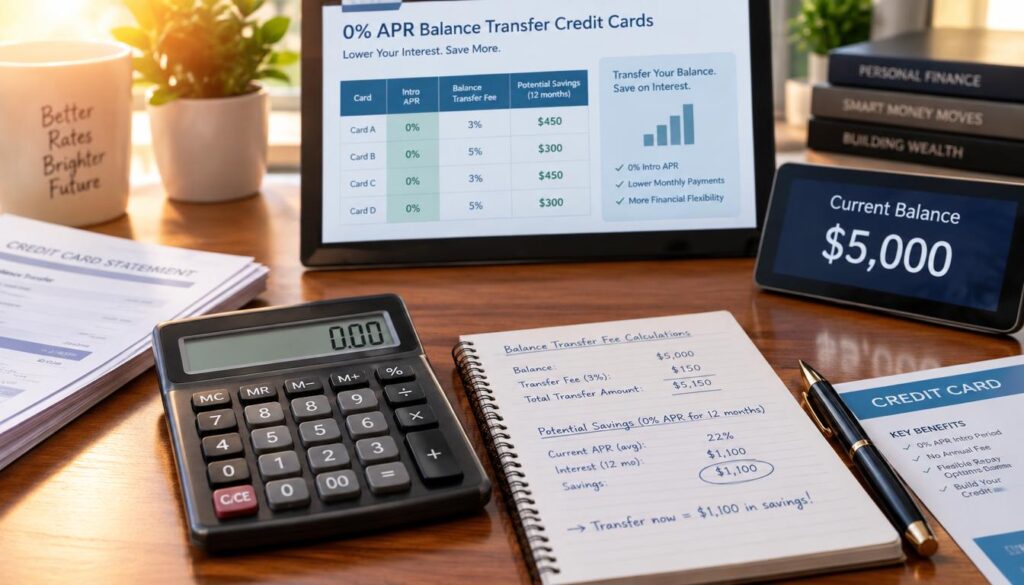
A $6,000 balance at 21% APR, paid only through minimum payments, could accrue over $9,000 in interest across two decades. The total paid would reach $15,874.
Moving that $6,000 to an 18-month 0% offer with a 3% fee adds $180. Paying at least $343 each month clears it within the offer for $6,180 total.
Calculate the fee on the balance we actually plan to move, not on the card’s full credit limit.
How Can We Pay Off $30,000 in Credit Card Debt?
We can plan a $30,000 payoff by dividing the amount owed, including any fee, by the months available and checking whether that payment fits the budget. The monthly target makes the repayment goal concrete.
To repay $30,000 over 21 months, we would need to pay about $1,429 monthly before any transfer fee. That math does not guarantee approval for a balance transfer or a large credit limit.
Paying off $10,000 over a 21-month 0% period takes about $476 per month. The same calculation scales to $30,000, but we must include any fee in the amount to repay.
We can use this four-step payoff plan:
- Total the balances and any transfer fees.
- Check the transfer card’s credit limit and issuer rules.
- Divide the payoff amount by the months available.
- Automate at least the minimum payment, then add enough to meet the target.
A balance transfer card may not accept the entire debt if the new credit limit or issuer-set cap is too low. We should not build a plan around an unapproved limit.
For example, add the fee to $30,000 before dividing by 21. If the fee were $900, the monthly target would be about $1,472.
We should also leave room in the budget for minimum payments on other accounts. Missing a payment can add costs and undermine the plan.
If the monthly target is not affordable, choose a longer repayment strategy rather than relying on minimum payments.
How Do 0% APR Applications Affect Credit Scores and Limits?
A 0% APR offer does not directly damage a score, but applying and using a large share of the new limit can affect it. The application and balance use matter, not the promotional rate itself.
FICO assigns 35% of a score to payment history and 30% to amounts owed. Those two factors together make up most of the score.
What makes up a FICO score?
| FICO factor | Share |
|---|---|
| Payment history | 35% |
| Amounts owed | 30% |
| Length of credit history | 15% |
| Credit mix | 10% |
| New credit | 10% |
Payment history reflects whether we pay bills on time. Amounts owed include how much of our available credit we use.
What can an application and credit limit change?
Applying for a credit card triggers a hard inquiry that can temporarily lower a credit score. FICO considers inquiries from the last 12 months, while they remain on a credit report for two years.
FICO’s five score factors show why one application is only part of the picture. High utilization can offset other good habits, especially if the new balance uses much of the credit limit.
Chase Freedom Unlimited applicants may receive a Visa Platinum version with a $500 minimum credit limit or a Visa Signature version with a $5,000 minimum. These are minimums for the versions, not guaranteed maximum limits.
A larger limit may make it easier to keep utilization low, but the issuer sets each applicant’s actual limit. A card’s minimum limit does not promise the limit we will receive.
Keep the balance below 30% of available credit when possible, and aim lower if the budget allows.
Should We Choose a Longer Intro APR or Better Rewards?
We should choose the longer offer when the payoff balance is the priority and choose rewards only when the shorter window still fits our budget. Our payment plan comes first.
Financing-focused cards commonly offer 18-21 months, while rewards cards often offer 12-15 months. The remaining balance accrues interest at the regular APR after the promotion ends.
A longer offer gives more payoff time
A longer intro APR offer can lower the monthly amount we need to pay, which may ease pressure on a tight budget. It helps only if we clear the balance before the regular APR starts.
We can divide the balance by the number of intro APR months to estimate a basic payment target. Add any transfer fee, then check whether that amount fits each month.
Some offers cover purchases, others cover balance transfers, and some cover both. A longer period is useful only when it applies to the balance we need to repay.
Rewards help only when they fit our spending
Rewards may keep earning value after an intro period, but they should not lead us to spend more. Cash back cannot make up for interest on a balance that remains.
A rewards credit card can be a sensible choice when its shorter period still matches our budget. Financing-focused cards may suit us better when a large balance needs more time.
We should compare the monthly payment needed under each offer, not just the reward rate or headline length. That keeps the decision tied to what we can repay.
Match the intro period to a payment amount we can sustain, not to the reward headline.
What Mistakes Can Make a 0% APR Offer Cost More?
A 0% offer can become expensive if we miss a deadline, transfer an ineligible balance, or leave debt unpaid at the end. Small timing errors matter when a promotion has strict rules.
The regular APR applies to any balance remaining when the intro period ends. Transfer amounts may also be limited by the new card’s credit limit or an issuer-set cap.
Mark the transfer deadline and payoff date, then keep new spending out of the repayment plan.
We can avoid four common mistakes:
- Missing the transfer window after account opening.
- Assuming a same-bank transfer will work.
- Adding new debt while paying down transferred debt.
- Carrying a balance past the intro period.
Some balance transfer offers require a transfer within a set window, such as 60 days or four months. We should check when the transfer must be completed.
Transfers generally cannot move between credit card accounts at the same bank. The receiving issuer sets eligibility rules, and some balances may not qualify.

New purchases can make repayment harder, especially if they do not receive the same intro APR. We should separate planned spending from the balance we are trying to clear.
Transfer limits also depend on the receiving issuer and available credit. A card may approve less than the total debt we hope to move.
Put the transfer deadline and payoff date on the calendar as soon as the account opens.
Conclusion
The best fit is the card whose eligible 0% period gives us enough time to pay down the balance without relying on new spending. We should match the offer to purchases or a balance transfer, then check that the transaction qualifies.
Our next step is to total the balance and any fee, then divide that amount by the months available. That gives us a monthly payoff target we can compare with our budget.
Before applying, write down the payoff target and confirm the offer’s transaction rules, transfer deadline, and regular APR.