A card that fits your spending and travel habits can be more useful than the biggest advertised bonus, which is why the Best Travel Rewards Credit Cards deserve a careful look. The right choice depends on how often you travel, which rewards you can use, and what annual fee feels comfortable.
We compare flexible-points cards, airline and hotel cards, and options with no annual fee. A transfer partner is an airline or hotel loyalty program to which a cardholder can move eligible rewards points. Welcome offers, card terms, and rewards can change, so compare the current offer with the card’s lasting value.
Some cards earn membership rewards points that can move between programs. Others earn rewards tied to one airline or hotel, or cash back for travel spending. Foreign transaction fees and a calendar year limit can also affect how useful a card feels abroad.
Key Takeaways
- Match rewards to spending and trips you already plan.
- Compare an annual fee with benefits you will use.
- Flexible points can offer more than one booking route.
- Airline and hotel cards reward loyalty to one brand.
- A $0 annual fee does not guarantee travel bonuses.
- Choose a card only if its ongoing rewards and benefits make sense after the welcome offer is gone.
Best Travel Rewards Credit Cards for Different Travel Styles
For most travelers starting with flexible rewards, the Chase Sapphire Preferred® is the clearest first card to compare. It combines a moderate annual fee with points that can work across travel options.
The largest welcome bonus is not automatically the best long-term fit. We should compare ongoing earning and useful benefits, not just bonus points available after a new card opening.
Compare recurring value against the annual fee before treating a welcome offer as a reason to apply.
The Capital One Venture Rewards Credit Card suits people who prefer simple earning on everyday purchases. The Venture X adds premium travel benefits at a lower fee than the Sapphire Reserve. Travelers who will use the Reserve’s premium benefits may find its higher fee worthwhile.
| Card | Annual fee | Everyday earning | Best fit |
|---|---|---|---|
| Chase Sapphire Preferred® | $95 | 5 points per $1 on Chase Travel; 2 on other travel | Flexible rewards starter |
| Capital One Venture Rewards Credit Card | $95 | 2 miles per $1 on every purchase | Simple everyday earning |
| Capital One Venture X Rewards Credit Card | $395 | 2 miles per $1 on every purchase | Premium travel at a lower fee than Reserve |
| Chase Sapphire Reserve® | $795 | 1 point per $1 on other purchases | Frequent travelers using premium benefits |
These credit cards suit different spending habits, even when each offers travel rewards. The Preferred earns 5 points per $1 on Chase Travel and 2 points per $1 on other travel purchases. The Venture and Venture X each earn 2 miles per $1 on every purchase.
For a broad group, the Preferred is a useful place to start comparing flexible rewards. A person who wants to earn points without tracking bonus categories may prefer Venture. A higher fee makes sense only when its cardholder values the added travel benefits.
Compare a card’s recurring value against its annual fee before treating a welcome offer as a reason to apply.
Which travel rewards card is easiest to start with?
A beginner can keep the decision simple by choosing one card that rewards spending they already do. The easiest start is usually a card with clear earning and a redemption method you understand.
Review the full credit and income criteria before applying. A card’s advertised audience does not guarantee approval, and a new card should not force extra spending.
The Credit One Bank Wander American Express Card is described as available to applicants with at least fair credit. It earns 5X points on eligible travel, including flights, dining, and gas. It earns 10X on eligible hotels and rental cars booked through Credit One Bank’s travel partner site.
Wander points can be redeemed for 1 cent each toward statement credits. That is simple to understand, but less flexible than rewards that can move to airline or hotel programs. It may suit a beginner who values statement credits over award bookings.
Before choosing a rewards credit card, check the details that shape its cost and use:
- Annual fee and any fee after an introductory period.
- Spending threshold for a welcome offer.
- How and when you can redeem rewards points.
- Payment due date and payment options.
- Foreign transaction fees on purchases abroad.
Those checks can make the best travel credit cards for beginners easier to spot. A card earns little real value if you miss a payment or pay interest. Paying a statement balance in full avoids interest charges that can outweigh rewards.
Do not spend extra to reach a bonus if the purchases would not otherwise fit your budget.
What does the Chase Sapphire Preferred® offer travelers?
Travelers who want Chase points without a premium-card fee can start by comparing the Preferred’s $95 annual fee with its travel and hotel benefits. The card offers flexible Chase rewards without a premium fee.
In 2026, the offer is 75,000 points after $5,000 in purchases during the first three months. The card also earns 5 points per $1 on Chase Travel and 2 points per $1 on other travel purchases.
The difference between Chase Travel and other travel purchases matters. A travel booking made through Chase Travel earns the portal rate, while other travel purchases earn the separate travel rate. Check how a booking is coded if it does not fit either expectation.
The card provides up to $100 in statement credits each account anniversary for hotel stays booked through Chase Travel. It also earns 3 points per $1 on dining and select categories listed in its offer terms.
Chase Ultimate Rewards points can be redeemed through Chase Travel or transferred to airline and hotel partners. That choice can help cardholders use rewards for flights, hotel stays, or portal bookings. The value depends on the price and award space for the trip.
The card can earn on dining and select everyday categories as well as travel. Its welcome offer can provide a strong first-year balance, but the annual fee remains after that offer ends. Compare its regular earning with your usual spending.
Check whether Chase Travel prices and partner award availability suit the trips you actually plan to book.
Is the Chase Sapphire Reserve® worth its annual fee?
The Reserve can justify its $795 annual fee for frequent travelers who will use several of its credits and lounge benefits. Its value is strongest for frequent travelers with plans that match those perks.
Count only benefits you would naturally use, not every advertised credit. The Reserve has a $795 annual fee, and each authorized user costs $195.
How the welcome offer and earning rates work
The 2026 offer gives 100,000 points after $6,000 in purchases during the first three months from account opening. That spending target is substantial, so it should fit planned expenses.
Ongoing earning is strongest on Chase Travel and direct flight and hotel bookings. The card earns 8 points per $1 on Chase Travel, 4 on flights and hotels booked directly, 3 on restaurant dining, and 1 on other purchases.
Which annual credits can offset the fee?
The Reserve offers up to $300 annually in travel statement credits in 2026. This general travel credit is separate from its other limited credits.
The Edit℠ offers up to $500 annually for prepaid bookings in 2026. A separate hotel benefit offers up to $250 through December 31, 2026, for prepaid Chase Travel bookings with listed participating hotel groups and a two-night minimum stay.
The card also offers up to $300 in dining credits during 2026. It splits the amount into up to $150 from January through June and up to $150 from July through December at participating Sapphire Reserve Exclusive Tables restaurants.
These are separate caps with separate booking or spending rules. A traveler should count only credits that match trips and meals already in their plans. A credit that expires unused does not lower the real cost.
What lounge and travel extras matter most?
The Reserve includes access to every Chase Sapphire Lounge by The Club, with up to two guests. It also offers access to more than 1,300 Priority Pass lounges worldwide.
The card has no foreign transaction fees, which can help on international trips. It also reimburses up to $120 for a Global Entry, TSA PreCheck, or NEXUS application fee once every four years.
For lounge access and international travel, the Reserve fits travelers who value Chase and Priority Pass access and want no foreign transaction fees. A lower-fee card may suit someone who will not use these credits or lounges.
Subtract only benefits you would have used without the card when judging its real annual cost.
Which Capital One Venture card fits your travel habits?
A traveler who wants a simple earning rate can start with Venture, while Venture X adds value for frequent portal users. The main difference is the fee and premium travel benefits.
Venture earns 2 miles per $1 on every purchase for a $95 annual fee. Venture X costs $395 annually and also earns 2 miles per $1 on every purchase.
The Venture Rewards Credit Card earns 5 miles per $1 on hotels, vacation rentals, and rental cars booked through Capital One Travel. Its flat everyday rate can suit travelers who want a simple rewards routine.
The Venture X Rewards Credit Card earns 5 miles per $1 on flights and vacation rentals booked through Capital One Travel. It earns 10 miles per $1 on hotels and rental cars booked through the portal.
Venture X also includes a $300 annual Capital One Travel credit, 10,000 anniversary miles, and access to Capital One and participating Priority Pass lounges. Those perks can help frequent portal users, but only when their trips match the booking rules.
We can compare the two cards with a few practical checks:
- How often will you book through Capital One Travel?
- Does your travel budget go more toward flights or hotels?
- Will you use the available lounge access?
- Can you use the annual credit for a planned trip?
- Does the higher fee fit your budget?
A traveler with few portal bookings may find the Venture easier to manage. A person who regularly books hotels and rental cars through Capital One Travel may gain more from Venture X. The anniversary miles matter only if you can put them toward a trip.
Compare the Venture X fee against the credit and lounge benefits you will genuinely use, not their advertised face value.
Which American Express card matches premium travel spending?
The Platinum is built around premium travel, while the Gold’s strongest earning categories center on dining and groceries. The right match depends on where your usual spending goes.
Both cards have higher annual fees than the Preferred. The Platinum Card® from American Express costs $895 per year, while the American Express® Gold Card costs $325.
The Platinum earns 5X points on flights purchased directly from airlines or through American Express Travel. This rate applies to up to $500,000 of those purchases per calendar year.
The Platinum suits frequent flyers who will use its premium travel and lounge benefits. Its high fee is harder to justify for travelers who fly rarely or do not value those extras.
The Gold earns 4X at restaurants worldwide on up to $50,000 per calendar year. It also earns 4X at U.S. supermarkets on up to $25,000 per calendar year, plus 5X on prepaid hotel stays booked through Amex Travel.
The Gold lists up to $120 in annual dining credits and up to $100 in annual Resy credits. It also lists up to $84 in annual Dunkin credits and up to $120 in annual Uber Cash.
Those credits have conditions and may require specific merchants, accounts, or uses. We should not value them like unrestricted cash unless we already use the services. A credit that changes our routine can be worth less than its face amount.
Gold is more relevant to people who spend heavily on food and groceries. Platinum is a closer fit for frequent flyers who use premium travel perks. Compare both against ordinary spending, not an idealized year.
Add up only the credits you can use naturally before accepting either card’s annual fee.
Which travel rewards cards have no annual fee?
A no-annual-fee card can keep rewards earning inexpensive, but the right choice depends on whether the traveler wants cash back or airline miles. The best fit depends on the kind of reward you use.
A $0 annual fee does not mean every travel purchase earns a bonus. Some cards reward rotating categories or purchases with one airline.
| Card | Annual fee | Main travel or rewards feature |
|---|---|---|
| Chase Freedom Flex® | $0 | 5% cash back on activated quarterly bonus categories |
| United Gateway℠ Card | $0 | Up to 50,000 bonus miles after qualifying activities in 2026 |
| Capital One Savor Student Cash Rewards | Not stated | 5% back on hotels, vacation rentals, and rental cars booked through Capital One Travel |
The Chase Freedom Flex® earns 5% cash back on up to $1,500 in combined purchases in activated quarterly bonus categories. Cardholders must activate each category, and spending above that cap does not earn the same rate.
The United Gateway℠ Card is most useful to United flyers who want airline miles without an annual fee. Its 2026 offer provides up to 50,000 bonus miles after qualifying activities.
The Capital One Savor Student Cash Rewards card has a travel booking condition. Its 5% rate applies to hotels, vacation rentals, and rental cars booked through Capital One Travel. It may fit students who use that portal for those purchases.
A general rewards card can earn cash back across selected categories. An airline card ties its main value to one carrier and its routes. Compare the rewards you can use, not just the fee line.
Check the bonus-category activation and spending cap before relying on a rotating rate.
Which United card makes sense for your flights?
A United loyalist can choose between a no-fee mileage card, occasional club visits, and a full United Club membership. The best match depends on how often United flights fit your plans.
United-specific benefits matter most to people who fly United often enough to use them. A card’s fee may not pay off when your routes rarely include the airline.
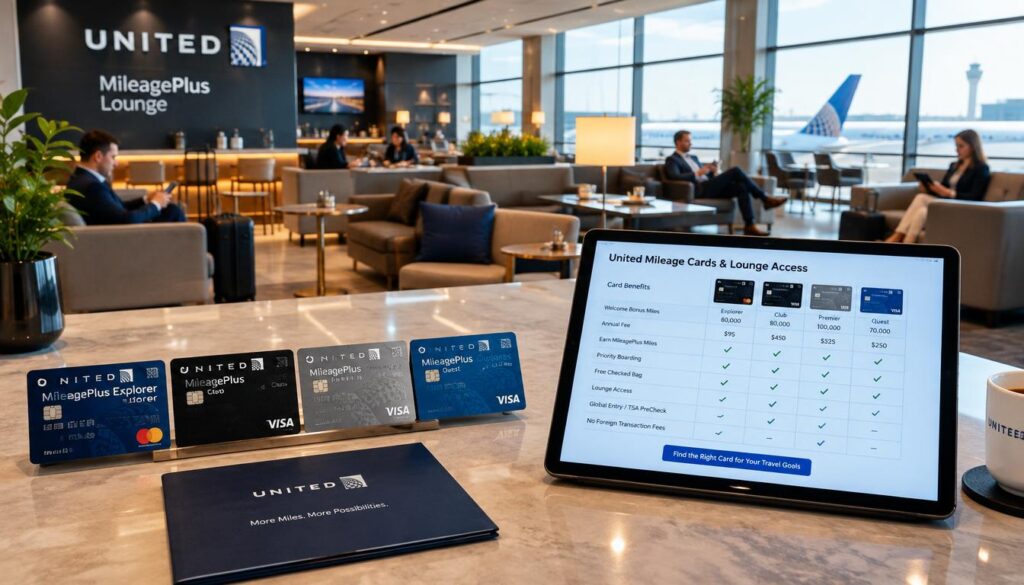
These four cards offer different levels of airline benefits:
- United Gateway℠ Card: $0 annual fee and an offer of up to 50,000 bonus miles after qualifying activities in 2026.
- United Explorer Card: $0 introductory annual fee for the first year, then $150, with two United Club one-time passes each year.
- United Quest℠ Card: $350 annual fee, a $200 United travel credit, and an annual 10,000-mile award flight discount.
- United Club℠ Card: $695 annual fee and United Club access.
The Gateway is the low-fee entry point for earning United miles. The Explorer gives occasional lounge visits through two one-time passes, not unlimited lounge access. The Quest adds a travel credit and an award flight discount.
United Club membership may suit a frequent flyer who will use the club during many trips. A traveler who only flies United once or twice may not get enough from a higher annual fee. Lounge access is useful only when it aligns with departure airports and schedules.
Estimate how often you will fly United before paying for airline-specific benefits.
Which Southwest card offers the best ongoing value?
Southwest flyers should compare anniversary points and flight earning against each card’s yearly fee. The best value depends on how often Southwest serves your planned routes.
The Priority card costs $229 and provides 7,500 anniversary points each year. Lower-fee cards provide fewer anniversary points, so frequent Southwest flyers should compare the gap with their actual travel.
| Card | Annual fee | Anniversary points | Southwest earning rate |
|---|---|---|---|
| Southwest Rapid Rewards® Priority Credit Card | $229 | 7,500 | 4X on Southwest purchases |
| Southwest Rapid Rewards® Premier Credit Card | $149 | 6,000 | 3X on Southwest purchases |
| Southwest Rapid Rewards® Plus Credit Card | $99 | 3,000 | 2X on Southwest purchases |
The Premier provides 6,000 anniversary points for a $149 annual fee. The Plus costs $99 and provides 3,000 anniversary points. The Priority earns 4X on Southwest purchases, compared with 3X for Premier and 2X for Plus.
The Southwest Rapid Rewards® Premier Business Credit Card offers a business option. It has a $149 annual fee, provides 6,000 anniversary points, and earns 3X on Southwest purchases. Business travelers should still compare that offer with their company’s route needs.
Anniversary points may help reduce the cost of a planned Southwest trip. They are less useful if the airline does not fly to your usual destinations or if you rarely book its flights.
Choose the higher-fee option only when its extra points or airline benefits match trips you already take.
Are hotel cards better than flexible travel points?
A hotel card is most compelling when its free-night or loyalty benefits fit stays you already expect to book. The key tradeoff is hotel loyalty versus a wider choice of rewards.
Hotel cards suit regular guests at one chain, while flexible points suit travelers whose hotel choices change. A free night can be useful when its rules fit a planned stay.
The Marriott Bonvoy Boundless® has a $95 annual fee and earns up to 17X total points per dollar at participating Marriott hotels. It includes an anniversary free-night award and 15 Elite Night Credits.
Marriott Bonvoy Bold® has no annual fee and earns up to 14X total points per dollar at participating Marriott hotels. Marriott Bonvoy Bountiful® costs $250 annually and earns up to 18.5X total points per dollar at participating Marriott hotels.
The World of Hyatt Credit Card costs $95 per year, earns up to 9X total points per dollar at Hyatt hotels, and includes an annual free night. The IHG One Rewards Credit Card has no annual fee and earns up to 17X total points per dollar at IHG hotels.
Those advertised hotel earning totals can include rewards beyond the card’s base earn. Check the card terms and the hotel program’s rules to see what makes up the total. A large number may not mean the card alone earns that amount.
Hotel-specific rewards can work well when stays regularly fall within one program. Flexible points can be a better fit when you compare several chains or book independent hotels. The choice also depends on whether free-night awards have open dates where you travel.
Check award availability at your usual destinations before choosing a card tied to one hotel program.
How can flexible points turn into useful trips?
Flexible points offer a choice between booking through a card portal and moving rewards to a partner program. The best route depends on price, availability, and the trip you want.
Compare the booking price before choosing a portal or transfer. A lower points price can matter more than a familiar redemption path.
Redeeming through a travel portal
A card issuer’s travel portal lets cardholders book flights or hotels using eligible rewards points. It can feel straightforward because travelers search and book in one place. The price may differ from a direct booking.
Compare the issuer travel portal with the airline, hotel, or another booking site before using points. Check the cash price, the points required, and any booking limits. A simple portal booking is not always the best value.
Keep the trip details in view when comparing. A portal may show an available flight that does not match the fare rules you want. Direct booking can also make it easier to manage a change with the airline or hotel.
Transferring points to airline and hotel partners
Transfers can open access to airline or hotel award bookings. Chase Ultimate Rewards points can move to partners including United, Hyatt, British Airways, and Southwest. Each program may price awards in its own way.
Check award availability before transferring points because a transfer may be irreversible. A transfer partner is an airline or hotel loyalty program that accepts eligible points from a cardholder’s rewards account. Once points leave the flexible account, they may not return.
The British Airways Visa Signature® has a $95 annual fee and a listed offer of 75,000 Avios after $5,000 in purchases within the first three months from account opening. Avios can price awards by distance, which may make short direct routes useful in some cases.
A short flight with available award seats may need fewer Avios than a longer route. But the best use depends on the route, dates, and points required. Compare the cash fare with the award before moving rewards.
Confirm award space and the transfer ratio before moving points out of a flexible rewards account.
How should business travelers compare rewards cards?
Business owners should match a card’s bonus categories to expenses they already pay for. The right structure depends on whether your business values points or cash back.
Do not count a welcome bonus as business income until you meet its terms. A spending target should fit normal business purchases rather than prompt extra costs.

These Ink cards differ in fee and earning style:
- Ink Business Preferred®: $95 annual fee; earns 3 points per $1 on travel and select business categories, up to the first $150,000 annually.
- Ink Business Cash®: $0 annual fee; earns rewards through selected bonus categories.
- Ink Business Unlimited®: $0 annual fee; earns 1.5% cash back on purchases.
Ink Business Preferred® lists a 100,000-point offer after $8,000 in purchases during the first three months. The spending requirement can suit a business with planned costs, but it should not change the budget.
Ink Business Cash® lists a $750 offer after $6,000 in purchases during the first three months. Ink Business Unlimited® lists a $750 cash-back offer after the same spending requirement.
Check whether each expense qualifies for the card’s categories and whether category limits fit your needs. Cash back may be easier to use than flexible rewards, while points may support eligible travel. Keep business purchases separate when that helps track expenses.
Compare the annual category caps with your actual business spending before applying.
What travel protections should you check before booking?
A card’s protection is useful only when the trip, traveler, and expense meet its written conditions. The conditions matter as much as the coverage limit.
Read the benefit terms before relying on a card for a costly trip. The Chase Sapphire Reserve® has coverage for some travel delays, baggage problems, rental car damage, cancellations, and emergencies.
Delays, baggage and rental-car coverage
The Reserve covers up to $500 per covered traveler for unreimbursed expenses when common-carrier travel is delayed more than six hours or requires an overnight stay. Baggage coverage can provide up to $100 per day for five days when baggage is delayed over six hours.
Primary rental-car theft and collision damage coverage can reach $75,000. The cardholder must decline the rental company’s collision insurance and charge the full rental cost to the card. That coverage does not mean every rental cost disappears.
These limits depend on the trip and the claim meeting the card’s rules. Keep booking records and receipts to show what happened and what you paid. A card benefit does not replace every kind of travel insurance.
Cancellations and emergency travel
The Reserve covers up to $10,000 per covered traveler and $20,000 per trip for covered prepaid, non-refundable travel expenses. The trip must be canceled or cut short for a covered reason.
Emergency medical services and transportation can reach $100,000 when a covered traveler becomes sick or injured at least 100 miles from home during a trip. The person, reason, and expense must meet the written terms.
| Benefit | Maximum stated coverage | Trigger or condition | Reserve example |
|---|---|---|---|
| Trip cancellation/interruption | $10,000 per traveler; $20,000 per trip | Covered reason; prepaid, non-refundable costs | Covered travel expenses |
| Emergency medical services and transportation | $100,000 | Covered sickness or injury at least 100 miles from home | Medical services and transportation |
| Trip delay | $500 per covered traveler | More than 6 hours delayed or overnight stay required | Unreimbursed expenses |
| Baggage delay | $100 per day for up to 5 days | Baggage delayed over 6 hours | Essential purchases |
Travel protection does not waive every rental-car cost or replace all travel insurance. Coverage may exclude a cause, traveler, or expense that seems related to a trip. Read the exact benefit terms before relying on a card for a major loss.
Read the benefit terms before a trip and keep the receipts and booking records needed for a claim.
Which application rules can affect your next card?
Application policies can rule out a card even when its rewards look like a good fit. The key timing rule for Bank of America limits some recent applications.
As of July 7, 2026, Chase’s 5/24 rule no longer applies to credit card applications. Neither that policy change nor another rule guarantees approval.
Bank of America’s 2/3/4 rule
Bank of America’s 2/3/4 rule limits approvals to two new Bank of America credit cards within 30 days. It also limits approvals to three within 12 months and four within 24 months.
This is a bank-specific application policy, not a promise of approval when you fall within each limit. Issuers may review applications under their current standards, and each applicant’s profile is different.
How to interpret Chase’s 5/24 rule
As of July 7, 2026, the Chase 5/24 rule no longer applies to credit card applications. Earlier, the rule was known as a limit tied to new accounts, but the stated current status is that it no longer applies.
Application rules can change, and a card’s listed offer does not settle the approval decision. Check the issuer’s current terms before planning several applications. Spacing applications can also help when new credit inquiries may affect a near-term loan application.
Check the issuer’s current application terms before planning a sequence of applications.
How many travel rewards cards should you carry?
One to three well-chosen cards is a manageable starting point for many travelers. The right number depends on how much spending and account tracking you can handle.
One everyday card plus one travel-focused card can be enough for many households. More cards make sense only when their extra rewards or benefits outweigh the added work.
Keep the number of cards low enough that every due date and benefit stays on your radar.
Each extra card adds another payment date, fee, and set of benefit terms to track. A card can also have category caps or credits that expire. Those details can be easy to miss when several accounts compete for attention.
Use this short list to check whether your card setup still works:
- Payment due dates and reliable payment reminders.
- Annual fees and whether each account earns its cost.
- Category caps that limit bonus rewards.
- Credits you did not use during the year.
- Account activity and any card you rarely use.
Carrying more cards does not mean you should spend more. A credit limit is not permission to go beyond a budget, and interest can outweigh rewards. Pay attention to the spending you can repay in full.
Keep only the accounts whose benefits you can use and whose payments you can reliably manage.
Conclusion
The right travel card rewards the trips and purchases already in your plans. Match its earning categories and benefits to your routine, then check the current annual fee and offer terms.
Select one or two finalists and estimate the value of benefits you will actually use. Leave out credits that would change your spending or go unused. A welcome bonus matters less than a card that fits your budget after the offer ends.
Compare your finalists’ current terms, then apply only when the fee, spending requirement, and benefits fit your budget.