A person carrying high-interest card debt can use an introductory 0% offer to put more of each payment toward the amount owed. The Best Balance Transfer Credit Cards can help us compare options for a clear debt payoff plan. A balance transfer moves existing card debt to a different issuer’s card. A balance transfer fee is a charge added to the new card balance when debt is moved from another card.
During an intro APR period, the card may charge no interest on transferred debt. That can leave more of each payment to reduce the credit card debt itself. The best fit depends on how long repayment may take, the fee, and the chance of approval. Any balance left after the promotional period faces the card’s regular APR.
We look at offers for different payoff timelines and needs, including cards with rewards and added features. A long offer can help, but it does not make a fee or future rate disappear. Compare the fee and the time available to repay before choosing an offer.
Key Takeaways
- Compare the intro APR period with the time you need to repay.
- Include the balance transfer fee in your payoff target.
- Check the regular APR for any balance left after the offer.
- Approval depends on more than a credit score.
- Keep paying old accounts until each transfer posts.
Best Balance Transfer Credit Cards for Different Payoff Goals
Four cards in this shortlist offer a 0% balance-transfer period of 21 months or 21 billing cycles. That extra time can help when a balance needs steady payments, though the right balance transfer card depends on the rest of its terms.
Four of the five listed options provide 21 months or 21 billing cycles at 0%. Here are their intro APR periods, regular APRs, and annual fees as listed in October 2026.
| Card | Balance-transfer intro APR period | Regular APR | Annual fee |
|---|---|---|---|
| Citi® Diamond Preferred® Card | 0% for 21 months | 16.74%-27.49% variable | $0 |
| Wells Fargo Reflect® Card | 0% for 21 months on qualifying transfers | 17.74%, 24.24% or 28.49% variable | $0 |
| U.S. Bank Shield™ Visa® Card | 0% for 21 billing cycles | 17.24%-28.24% variable | $0 |
| Chase Slate® | 0% for 21 months | 18.49%-28.49% variable | $0 |
| Discover it® Chrome | 0% for 18 months | 17.74%-26.74% variable | $0 |
Four listed cards give 21 months or 21 billing cycles at 0%, but billing cycles do not always match calendar months.
Which cards offer the longest time to repay?
Citi Diamond Preferred, Wells Fargo Reflect, U.S. Bank Shield, and Chase Slate have the longest listed periods here. A billing cycle is the time between account statements, so 21 billing cycles may not equal 21 calendar months.
That wording matters when we set a payoff date. A cycle can start on a different day for each account, and the end date follows the issuer’s schedule. Check the specific offer period before planning the final payment.
Which option fits a simpler, no-rewards payoff plan?
Wells Fargo Reflect may fit someone who also values its purchase offer. Citi Diamond Preferred is a straightforward transfer-focused choice for a reader who wants to focus on existing debt.
Compare whether a purchase APR offer matters more than transfer-only features. The credit score and other details an issuer reviews can affect approval, so no card is a sure fit for every applicant. Check whether a listed offer’s period is measured in months or billing cycles before comparing payoff dates.
Which Balance Transfer Cards Also Offer Rewards?
A rewards card can keep offering value after the transferred balance is gone, but its promotional period may be shorter than a no-frills option. Rewards are secondary when the main goal is clearing debt.
Cash rewards do not reduce the balance-transfer fee or erase interest automatically. The table compares four cards with rewards and balance-transfer offers.
| Card | Balance-transfer intro period | Rewards feature | Annual fee |
|---|---|---|---|
| Citi Double Cash® | 0% for 18 months | 2% cash back, plus 5% on eligible Citi Travel bookings | $0 |
| Discover it® Chrome | 0% for 18 months | Cash back on eligible purchases | $0 |
| Bank of America® Customized Cash Rewards credit card | 0% for 15 billing cycles on transfers made in first 60 days | Cash back in a chosen category | $0 |
| Chase Freedom Unlimited® | 0% for 15 months | Cash back on eligible purchases | $0 |
What can rewards add after debt payoff?
Cash back may add value once the balance is paid and the card fits regular spending. It should not change the amount we can afford to pay toward debt each month.
The Citi Double Cash earning structure gives 1% when buying and 1% as the cardholder pays. Eligible Citi Travel bookings earn 5%. Those rewards come from eligible activity, not from moving a balance.
Which cards combine rewards with a promotional period?
Citi Double Cash pairs an 18-month balance-transfer intro APR with its cash rewards. Discover it Chrome also offers 18 months, while Bank of America Customized Cash Rewards and Chase Freedom Unlimited offer shorter listed periods.
Blue Cash Everyday® is another option to review: it has a 15-month 0% intro APR on purchases and balance transfers, with a $0 annual fee. Compare the fee and timing before treating any reward as a benefit. Prioritize the repayment deadline over rewards if the debt will take nearly the whole promotional period to clear.
What Happens During a Balance Transfer?
A balance transfer shifts existing card debt to another account rather than forgiving or reducing the amount owed. The debt moves, and the balance plus any fee appears on the receiving account.
Keep making required payments on the old card until the transfer posts. Balance-transfer cards commonly offer a promotional APR for a set period, and 0% offers typically last 12-21 months.
A card balance transfer generally moves debt between different card issuers. In most cases, we cannot move a balance between two cards from the same issuer. The basic steps are:
- Request the transfer through the new card issuer.
- The new issuer pays the old card issuer for the approved amount.
- The transferred balance and any fee appear on the new account.
The old account may still show the debt while the request is processing. The transfer does not wipe out the amount owed, and the new card’s available credit can limit how much moves.
Keep paying the old card until its balance reflects the completed transfer. If the old account’s due date arrives first, pay at least its required minimum to avoid a late payment.
Who Can Qualify for a Balance Transfer Card?
A score around 670 or higher is a common starting point for strong balance-transfer offers, but it does not guarantee approval. Issuers look beyond scores when they review a credit card application.
Good-to-excellent credit, often 670 or higher, is commonly expected for strong offers. Bankrate recommends a 670-850 score range for Citi Diamond Preferred and Wells Fargo Reflect. Experian lists a Good-Exceptional FICO® Score range for Citi Diamond Preferred.
Use this checklist before you apply:
- Review your current credit score and report.
- Check how many credit applications you have made recently.
- Assess current balances and available credit.
- Compare your likely approval chances with the issuer’s stated criteria.
Issuers may also consider income, credit history, existing available credit, and recent inquiries. A score in a recommended range is only one part of the review, not a promise of approval.
Look at your full credit picture rather than relying on one number. Apply only when the offer’s stated criteria and your recent credit history make approval plausible.
Which Offer Terms Matter Most?
A useful starting point is an introductory period of at least 15 months, then check whether your planned payment can clear the balance before it expires. A longer window can help with a larger balance.
Introductory balance-transfer APR offers commonly run 12-21 months. The payoff date matters as much as the offer length.
How long should the introductory APR last?
Bankrate recommends comparing cards with at least 15 months at 0%. That gives us a useful baseline when comparing offers, though a shorter period may still fit a small balance.
A longer period can suit a larger debt when the monthly payment remains manageable. Estimate what you can pay each month, then see whether those payments clear the balance before the intro APR ends.
What happens when the promotional period ends?
The card’s regular APR applies to any unpaid balance after the promotional period. It does not apply retroactively to the original transferred amount, so the earlier 0% period does not turn into backdated interest.
That differs from deferred-interest financing, where a promotion may add earlier interest if the balance is not paid by a deadline. Variable APRs can also change over time. Compare the regular APR against your current rate if your payoff schedule leaves a balance after the offer.
How Much Does a Balance Transfer Fee Cost?
A 3%-5% fee means a $5,000 transfer can add $150-$250 to the amount you owe. The fee is upfront, even when the intro APR is 0%.
Transfer fees commonly range from 3%-5% of the amount moved and are generally added to the new balance. These examples show how the rate changes the cost.
| Transfer amount | Fee rate | Fee |
|---|---|---|
| $3,000 | 3% | $90 |
| $3,000 | 5% | $150 |
| $5,000 | 5% | $250 |
A minimum fee can make a small transfer cost more than the percentage alone suggests. For example, Citi Diamond Preferred charges 3% of each transfer, with a $5 minimum, for transfers completed in the first four months after account opening.
After that window, the Citi fee is 5%, with a $5 minimum. Bank of America Customized Cash Rewards charges 3% during the first 60 days from account opening, then 5%. Those examples show why the completion date can change the cost.
Compare the fee against the interest you would otherwise pay, not against the promotional APR alone. A fee is useful to weigh against real savings, not a rate in isolation.
How Much of Your Balance Can You Transfer?
A $5,000 credit limit might allow a transfer of about $3,750 under a common 75% planning rule, but the issuer sets the actual limit. Plan for less than the full credit line.
A transferable amount is often capped around 75% of the new card’s credit limit. That is a planning estimate, not a promise, and some issuers set a lower transfer limit than the approved credit line.
| New credit limit | 75% planning estimate | What controls |
|---|---|---|
| $5,000 | $3,750 before fees | Issuer’s actual transfer limit |
| $10,000 | $7,500 before fees | Issuer’s actual transfer limit |
| $15,000 | $11,250 before fees | Issuer’s actual transfer limit |
In the $5,000 example, $3,750 is available for transfer before accounting for any applicable fee. The issuer’s limit controls, and the fee also uses available credit.
Balances and fees both take up room on the new account. A transfer card may not cover every credit card balance, especially when the new limit is modest.
Balances at the same issuer generally cannot move to another card from that issuer. Leave room for the transfer fee when estimating how much available credit the debt will use.
How Can a Calculator Estimate Your Savings?
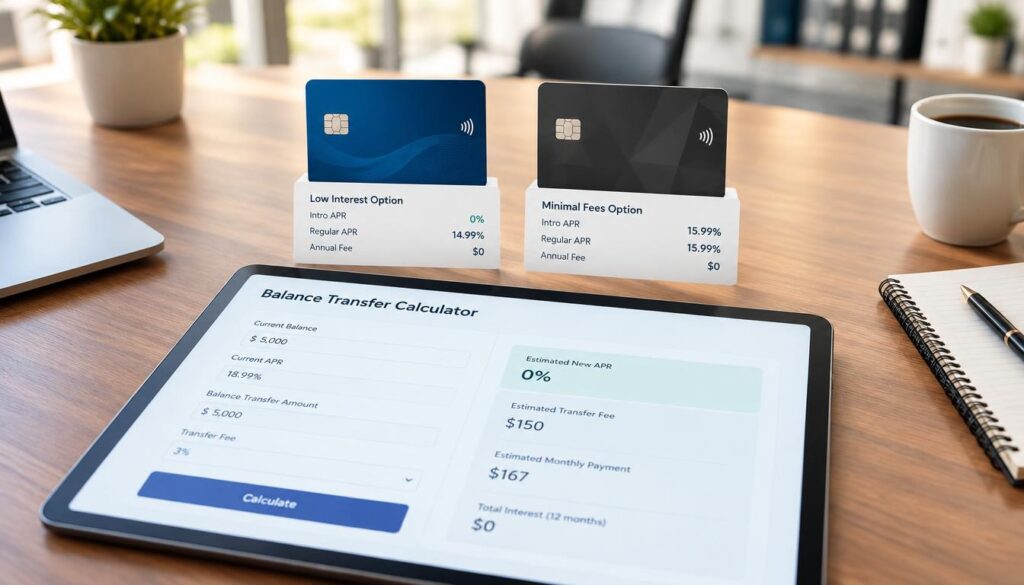
A calculator is useful when it compares the cost of keeping the balance with the fee and remaining interest after a transfer. It gives an estimate, not a promise about the final payoff or approval.
A balance-transfer calculator needs six inputs to compare the two paths:
- Current balance.
- Current APR.
- Monthly payment.
- Balance transfer fee.
- Regular APR after the promotion.
- Introductory period.
For example, a $3,000 balance at 27.49% APR requires $205 monthly for 18 months in one estimate, with $694 in interest. A $3,000 transfer with a 5% fee adds $150.
Paying $150 monthly over 21 months at 0% avoids interest during that period, though the fee still costs $150. Results depend on the payment and APR assumptions entered, and actual terms may differ.
A Discover balance or a Citi balance can go into a general calculator. The math depends on that card’s actual fee and offer terms, not on a special issuer-only formula.
Recalculate with a payment amount you can sustain rather than an optimistic monthly target. A lower but realistic payment gives a more useful estimate.
How Long Does a Transfer Take, and What Should You Do?
A transfer often clears in five to seven business days, though some take several weeks. Timing varies by issuer and by when the request arrives.
Keep paying each old account’s minimum until its transfer clears. Multiple transfers may need separate requests, and each balance can update on a different day.
| Timing | What it means | Action |
|---|---|---|
| Five to seven business days | Typical estimate | Keep old payments scheduled |
| Several weeks | Some requests take longer | Check each account balance |
| 14-day wait, then up to 10 days | Citi Diamond Preferred processing | Allow time after account opening |
Citi begins processing Diamond Preferred requests 14 days after account opening and may take up to 10 additional days. Citi requests must fit the initial account-opening window, and cardholders can modify or cancel requests during the first 14 days.
Many introductory transfer windows run 60-90 days. Check the exact deadline and allow time for processing rather than waiting until the last day.
Use these three actions when arranging one or more transfers:
- Confirm the offer’s transfer deadline and rules.
- Submit transfer requests promptly, including separate requests when needed.
- Keep paying old accounts until their balances clear.
Keep the old card payments scheduled until each transfer is confirmed as posted. A request alone does not clear the old balance.
Do Balance Transfers Affect Your Credit Score?
A new card application may cause a small, temporary score dip, while the transfer itself can change how much of your available credit is being used. The effect depends on whether you open an account.
Credit utilization makes up 30% of a FICO® Score, while payment history makes up 35%. A balance transfer does not guarantee a higher score.
What can change when you open a new card?
A new card application can lead to a hard inquiry, which may have a small, temporary effect. Several inquiries in a short time can have a greater negative effect.
A new account can also lower the average age of your accounts. Moving a balance between cards you already have does not create a new inquiry, and it leaves total available credit unchanged.
How can a transfer change utilization?
A new credit line can lower utilization if it adds enough available credit. Experts recommend keeping utilization under 30%, though a high balance on the new card can keep the rate elevated.
For example, moving $2,500 from cards with $4,000 in combined limits to a new card with a $5,000 limit raises total available credit to $9,000. Utilization falls from 63% to 28% in that example.
Repeatedly opening cards can hurt scores through inquiries, lower average account age, and accumulated fees. Avoid opening several cards in quick succession and keep older accounts open unless there is another reason to close them.
How Can You Pay Off the Balance Before the Intro APR Ends?
Divide the transferred balance plus fee by the months in the promotional period to set a simple starting payment target. That target is a floor if interest or other charges may apply.
Plan around the full amount owed, including the fee, not just the original balance. Use this checklist to build a realistic schedule:
- Total transferred amount, including the fee.
- Number of promotional months.
- Monthly payment target.
- Backup plan for any remaining balance.
One example starts with $6,519 at 21% APR and $419 monthly payments for 18 months. It accrues $1,158 in interest and costs $7,677 total. A 5% transfer fee makes the new balance $6,545.
At 0%, $419 monthly for 18 months pays that $6,545 balance with no interest. These estimates depend on the stated rate, fee, payment, and timing.
A separate $6,000 balance at 21% with minimum payments could cost $15,874 over two decades, including more than $9,000 in interest. Paying $250 monthly clears it in less than three years and adds $1,850 in interest, for $7,850 total.
A 3% transfer fee adds $180 to $6,000. Payments of at least $343 for 18 months clear $6,180, while $250 monthly takes 26 months and costs about $6,303 total.
Paying only the minimum may leave a substantial balance. Set autopay for at least the planned amount and verify that it clears the balance before the promotional rate expires.
What Card Features Matter After the Transfer?
A card’s extra features matter most after the debt plan is secure and the transferred balance is shrinking. These are extras, not a reason to add new debt.
Authorized users, phone protection, and score tools cannot replace a workable payoff plan. Check whether a benefit suits your needs before counting it as long-term value.
Citi Diamond Preferred lets cardholders add an authorized user at no additional cost. That feature may help a household manage access, but it does not change the repayment terms.
Wells Fargo Reflect includes up to $600 of cell phone protection against damage or theft, subject to a $25 deductible. Wells Fargo Credit Close-Up gives Wells Fargo Online® customers monthly FICO® Score updates and personalized credit insights without negatively affecting their scores.
Some balance-transfer cards have no ongoing rewards, so their value may be limited after payoff. Cash back matters most when purchases are paid in full rather than carried as new debt.
Read the benefit’s eligibility and deductible terms before counting it as meaningful value. A benefit is only useful when its rules match how you use the card.

When Might a Personal Loan Be a Better Alternative?
A personal loan can be worth comparing when the balance is too large for the available transfer limit or cannot be repaid during the offer period. A fixed schedule may suit someone who wants set payments.
Compare the loan’s fixed APR and fees with the card’s promotional rate and later regular APR. A balance left after the card offer ends may face that regular rate.
A loan may fit when the debt exceeds the amount the new card will accept. It can also suit a repayment timeline that runs longer than the promotional period.
Compare the loan’s set payment schedule with the changing balance on a transfer card. Include any loan fees in the total cost, not just the advertised interest rate.
Approval, APR, and fees depend on the borrower and the specific loan offer. A personal loan is not always cheaper or easier to get than a transfer card.
Compare the total borrowing cost and payment schedule for both options before committing. Choose the route that fits the amount and pace you can manage.
Is Citi Diamond Preferred or Wells Fargo Reflect a Better Fit?
Choose Citi Diamond Preferred if you want a no-rewards payoff tool, and consider Wells Fargo Reflect if its added protections and account services matter to you. Use matters most when weighing extra features.
Citi has no annual fee and no rewards, while Wells Fargo offers phone protection and account tools. Both cards can suit different preferences.
Citi Diamond Preferred may fit someone who wants a transfer-focused card and does not need rewards. It also lets cardholders add an authorized user at no additional cost.
Wells Fargo Reflect may appeal to someone who values up to $600 in cell phone protection for damage or theft. The coverage has a $25 deductible, so it is not the same as full reimbursement.
Wells Fargo Credit Close-Up offers monthly FICO® Score updates and personalized insights to Wells Fargo Online® customers. Eligibility is limited to those customers, and the service does not affect their scores.
Base the choice on the benefit you will actually use after checking its conditions. A feature that sits unused should not outweigh a fee or a payoff plan that does not fit.
What Mistakes Can Reduce Your Savings?
A low introductory APR helps only when the transfer is completed on time and new charges do not outpace repayment. Small oversights can add cost or leave debt on a higher-rate card.
Check the card agreement for late-payment rules and purchase grace periods. Promotional terms differ by card, so one missed payment does not always have the same result.
Meet the transfer deadline, keep old minimum payments current, and avoid purchases that can grow while you repay.
Watch for these five mistakes:
- Missing the transfer deadline, which commonly falls 60-90 days after account opening.
- Forgetting minimum payments on old accounts while requests process.
- Adding purchases to a transfer-only 0% offer.
- Paying only the minimum without checking the payoff date.
- Applying for several new cards close together.
Fees commonly add 3%-5% to the transferred amount, and the regular APR applies to any balance left after the promotion. Those costs can shrink the savings from a low intro APR.
Purchases on a card with a transfer-only 0% offer may accrue interest without a grace period while a transfer balance remains. Check the agreement for purchase rules and the effect of late payments on your specific promotion.
Set reminders for the transfer deadline, payment due date, and promotional end date. Each date protects a different part of the payoff plan.
Conclusion
The strongest choice is the offer that gives you enough time to repay without making the fee or future APR unmanageable. A long 0% period helps only when the monthly payment fits your budget.
We can make the choice clearer by calculating a sustainable payment and including the transfer fee. Check how the regular APR could affect any balance left after the offer ends.
Before applying, calculate your monthly target and confirm the transfer window in the card’s current terms.